



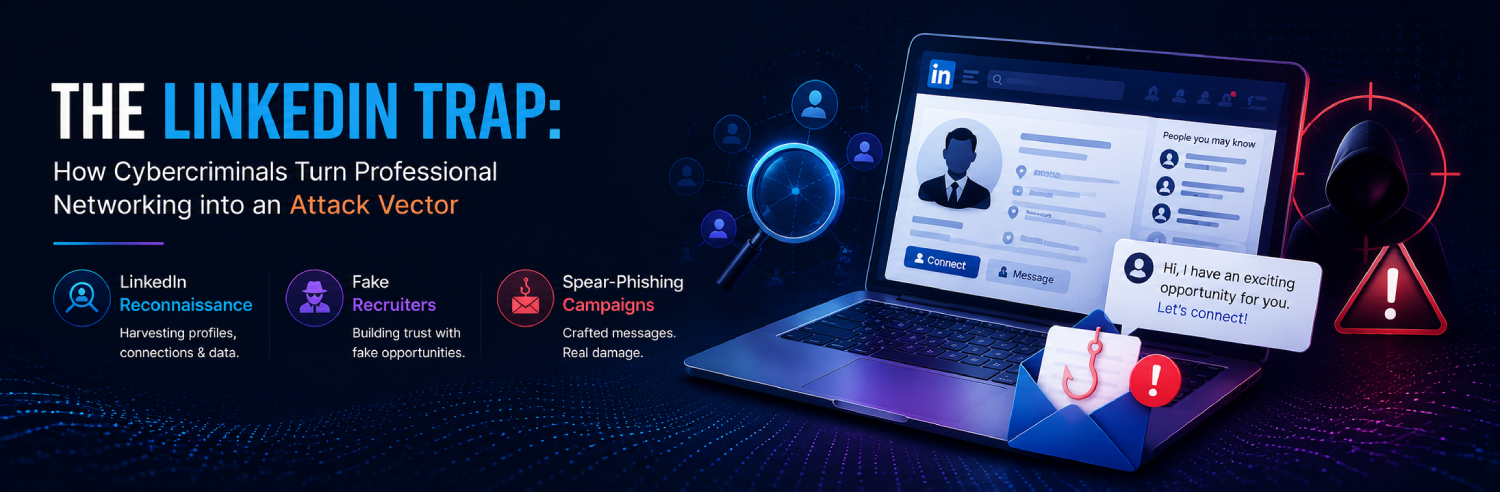
The LinkedIn Trap: How Cybercriminals Turn Professional Networking into an Attack Vector
LinkedIn occupies a strange and privileged place in our professional lives. It is the one platform where being approached by a stranger is not just normal but desirable. A connection request from someone we have never met is an opportunity, not an intrusion. A message from a recruiter is flattering. An interesting industry contact wanting to network is a good day. We have trained ourselves to lower our guard there by design, because lowering our guard is the entire point of the platform. Cybercriminals understand this perfectly, and they have made LinkedIn one of their most effective hunting grounds.
The danger is not that LinkedIn is full of obvious fraud. It is that the platform’s legitimate purpose—open professional connection—is indistinguishable from the early stages of a sophisticated attack. The recruiter offering your star engineer a dream role and the attacker laying the groundwork for a breach can look exactly the same in the first message. That ambiguity is the trap.
A Reconnaissance Goldmine Hiding in Plain Sight
Before any clever attack comes research, and LinkedIn is the richest, most willingly offered source of corporate intelligence ever assembled. Employees volunteer, in public, precisely the details an attacker needs to construct a convincing approach.
Consider what a single afternoon of browsing reveals. An attacker can map an organization’s structure—who reports to whom, who sits in finance, who holds privileged technical access. They can identify new hires, who are unfamiliar with internal norms and eager to prove themselves, and therefore unusually easy to manipulate. They can read about recent projects, deals, and reorganizations, harvesting the specific context that makes a phishing message feel authentic. They can find the names of real colleagues to impersonate and the tone of internal communication to mimic.
This matters enormously in the AI era, because AI scales reconnaissance the way it scales everything else. The same models that produce flawless phishing text can ingest LinkedIn profiles and generate tailored lures at volume. With AI-written phishing already achieving roughly 54% click-through versus about 12% for traditional phishing (Brightside AI), pairing that capability with LinkedIn’s detailed profiles produces attacks that feel less like spam and more like a colleague who happens to know exactly who you are and what you are working on.
The Fake Recruiter and the Dream-Job Lure
The single most effective LinkedIn attack pattern is the fraudulent recruiter, because it exploits ambition rather than fear. Most security training conditions people to be wary of threats and urgency. It rarely prepares them for an attack that arrives disguised as the best news of their career.
The approach is patient and flattering. A polished profile—often impersonating a real recruiter at a real firm, with a plausible photo and history—reaches out about an exciting opportunity tailored to the target’s actual experience. A conversation develops over days. Trust builds. Then comes the pivot: a job description to download, an assessment to complete, a portal to log into, or a call to schedule. Any of these can carry the payload—malware in the document, a credential-harvesting page behind the login, or simply the gathering of enough personal detail to mount a later attack.
What makes this so dangerous is the emotional context. A person evaluating a career-changing offer is hopeful, engaged, and motivated to keep the conversation alive. They are far less likely to scrutinize a file from someone who might hold their next promotion than they are to question an unexpected invoice. The attacker has chosen the one frame in which the target actively wants to believe.
From First Message to Spear-Phishing Campaign
LinkedIn is rarely the scene of the final crime. More often it is the staging ground—where trust and intelligence are gathered before the real attack moves to a channel where money or access changes hands. Understanding that progression is key to defending against it.
A typical campaign unfolds in stages:
1. Reconnaissance. The attacker studies profiles to identify targets, relationships, and context.
2. Connection and rapport. A connection request or message establishes a relationship that lends future communication credibility.
3. Pretext development. Conversation extracts useful detail—current projects, tools, travel, internal contacts.
4. The pivot. The attack moves to email, phone, or a fake portal, now armed with everything needed to be convincing.
This is also where LinkedIn feeds the multi-channel attacks now defining the landscape, with 41% of phishing incidents spanning email, SMS, QR codes, and voice. A relationship that begins on LinkedIn can continue by email and be reinforced by a phone call or text, each touchpoint making the others seem more legitimate. And because so much of this leads back to harvesting credentials or enabling fraud, it connects directly to the costliest outcomes—recall that BEC alone caused $3.046 billion in losses in the FBI’s IC3 2025 figures. The friendly LinkedIn message is often the first step on a road that ends at a fraudulent wire transfer.
Defending Against Threats That Wear a Friendly Face
The defining challenge of LinkedIn-based attacks is that the usual warning signs are absent. There is no urgency, no obvious threat, no broken English—just a courteous professional being helpful. So defense cannot rely on detecting hostility. It has to rest on healthy verification habits applied even, and especially, when nothing feels wrong.
The practical mindset is straightforward, if it can be made instinctive. Treat unsolicited opportunities and requests with calm skepticism regardless of how appealing they are, and verify identities independently—confirming a recruiter through the company’s official channels rather than trusting the profile alone. Be deliberate about how much detail you publish and discuss, since every specific you share is raw material for a tailored lure. And carry the same caution across channels, recognizing that a relationship begun on LinkedIn does not become trustworthy simply because it later moves to email or a call.
The harder part is that this mindset runs against the grain of how the platform is meant to feel, which is exactly why it cannot be left to a policy document. People need to practice recognizing these patterns in something close to the real experience—the too-good recruiter, the over-friendly new contact, the smooth pivot to a download or login. Practice is what turns abstract caution into a reflex that fires even when the message is welcome rather than alarming.
Stay Open Without Being Exposed
LinkedIn is genuinely valuable, and the answer is not to retreat from it. Careers are built, deals are made, and talent is found there every day. The goal is to keep the openness that makes professional networking work while closing the gap that attackers exploit—the assumption that a friendly, relevant, well-crafted approach must be legitimate. In an era where AI can study your people and craft the perfect message for each of them, that assumption has become a real liability.
Conclusion
LinkedIn turns its greatest strength—open professional connection—into an attack surface, because the legitimate first message and the opening move of a campaign can look identical. Attackers mine profiles for reconnaissance, exploit ambition through fake-recruiter lures, and use the platform as a staging ground before pivoting to email, phone, or fake portals across multiple channels. The usual warning signs are absent, so defense cannot rely on detecting hostility; it has to rest on verification habits applied even when nothing feels wrong. The aim is to stay open without being exposed.
How Shieldbyte Infosec Can Help
Shieldbyte Infosec built ShieldPhish to build instincts that hold up across every channel attackers use, including the social and professional platforms where the threat arrives wearing a friendly face. The platform runs realistic simulations of the patterns employees actually encounter—the too-good recruiter, the over-friendly new contact, the smooth pivot to a download or login—and pairs them with timely coaching that turns “verify before you trust” into a reflex. A human risk score shows where exposure concentrates, such as new hires or roles with privileged access, and adaptive training focuses support where it is needed most. Because so many of these campaigns begin friendly and end at a fraudulent transfer, practicing recognition early is what keeps openness from becoming liability. Reporting gives leadership a clear view of how resilient the workforce is across inbox, messaging, and networking channels alike. Helping your people tell a genuine opportunity from the opening move of a campaign, without losing the openness that makes networking worthwhile, is well worth the effort.