



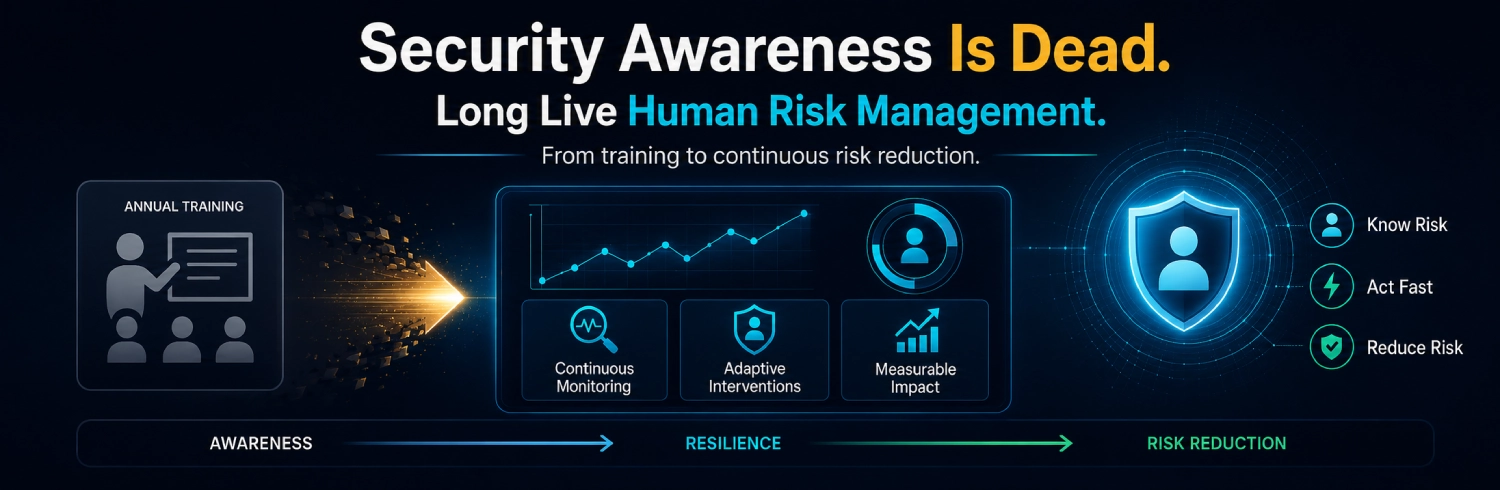
Security Awareness Is Dead. Long Live Human Risk Management
For the better part of two decades, the corporate answer to cyber risk involving employees has been remarkably consistent: run an awareness program. Once a year, often around audit season, staff log in to a learning portal, click through a series of slides about suspicious links and strong passwords, pass a short quiz, and return to their inboxes feeling vaguely more secure. The compliance box gets ticked. The certificate gets filed. Everyone moves on.
The trouble is that the threats did not move on with us. They evolved, and the old model has not kept pace. The uncomfortable truth that security leaders are now confronting is that traditional security awareness, as most organizations practice it, no longer meaningfully reduces risk. Verizon’s 2025 Data Breach Investigations Report found that click and failure rates were largely unaffected by traditional one-off training. In other words, the thing we have spent fortunes on for twenty years is not doing the job we assigned it.
This is not an argument that awareness was a waste. It is an argument that awareness was a starting point we mistook for a destination. What comes next is a more honest, more continuous discipline: Human Risk Management.
The Human Element Was Never the Weak Link, It Was the Whole Game
Let us begin with the scale of the issue, because it reframes everything. Roughly 60% of breaches involve a human element (Verizon 2025 DBIR). That figure is not a footnote; it is the headline. When most incidents trace back to a person clicking, approving, sharing, or trusting something they should not have, then the people in your organization are not a peripheral risk factor. They are the primary surface that attackers target.
For years we have spoken about employees as “the weakest link,” a phrase that is both unfair and unhelpful. It implies a flaw in the people rather than a flaw in how we have supported them. Your staff are not failing a test you set them well. They are operating in an environment where attacks have become dramatically more convincing while their preparation has stayed static. Phishing still accounts for a meaningful share of how breaches begin, around 16% of breaches start there, with phishing representing roughly 14% of breach action varieties (Verizon 2025 DBIR). These are not exotic, rare events. They are the steady drumbeat of modern business risk.
The shift to Human Risk Management starts by accepting this reality without blame. People are central, so managing the human dimension of risk has to be central too, not a once-a-year afterthought.
Why the Annual Slide Deck Stopped Working
There are a few reasons the traditional model has run out of road, and they are worth naming plainly.
The first is timing. A single annual session asks employees to retain and apply knowledge across twelve months of constantly changing threats. Human memory does not work that way. What you learned in March is faded by August, and the attack you face in November may not even have existed when you took the course.
The second is realism. Older training was built around a world of clumsy, typo-ridden scam emails. That world is gone. AI-generated phishing became the top enterprise email threat by late 2025, and AI-written phishing emails saw roughly 54% click-through compared with about 12% for traditional phishing, nearly four and a half times more effective, according to a Brightside AI study. The polished, personalized, grammatically flawless lure is now the norm. A course that prepares people for yesterday’s scams leaves them exposed to today’s.
The third is measurement. Annual training measures completion, not capability. It tells you who finished the module, not who would actually resist a well-crafted attack on a stressful Tuesday afternoon. Completion rates feel like progress, but they are activity, not outcome.
What Human Risk Management Actually Means
Human Risk Management, or HRM, reframes the entire effort around a simple idea: human risk is dynamic, measurable, and manageable, just like any other operational risk on the balance sheet. Rather than delivering a fixed event once a year, HRM treats risk reduction as a continuous process.
In practice, this looks quite different from the old model. Instead of one annual course, you have ongoing, bite-sized learning that responds to real behavior. Instead of treating every employee identically, you recognize that risk is not evenly distributed. A finance executive who approves payments is exposed differently than a warehouse supervisor. HRM identifies who carries the most risk, in which scenarios, and focuses attention accordingly.
Crucially, HRM is built on feedback loops. It observes how people respond to realistic simulations, identifies patterns, and adapts. When a particular department shows susceptibility to a specific tactic, the program responds with targeted reinforcement rather than another generic broadcast. The goal is not to catch people out. It is to build genuine, durable resilience that strengthens over time.
This continuous approach matters more than ever because attacks themselves have become multi-channel. Some 41% of phishing incidents are now multi-channel, blending email, SMS, QR codes, and voice. You cannot prepare people for a moving, multi-front threat with a stationary, single-channel course.
From Compliance Theater to Real Risk Reduction
Perhaps the most valuable thing HRM does is shift the conversation from compliance theater to genuine risk reduction. There is a meaningful difference between being able to prove you delivered training and being able to demonstrate that your people are measurably less likely to fall for an attack.
This distinction also resonates with regulators. India’s Digital Personal Data Protection Act, with rules finalized in November 2025 and full compliance expected by around mid-2027, expects organizations to maintain reasonable security safeguards, with penalties of up to ₹250 crore for failing to do so. A box-ticked annual course is increasingly thin evidence of “reasonable” diligence when the human element is so clearly central to breaches. A living, measurable program that demonstrably reduces human risk is a far stronger position, both for protecting data and for defending your decisions if scrutiny ever comes.
The financial logic reinforces it. With the global average cost of a data breach reaching $4.44M in IBM’s 2025 Cost of a Data Breach report, the return on reducing your most common breach pathway is substantial. Money spent making people genuinely more resistant is money that protects against your single biggest category of loss.
The Quiet Death of an Old Idea
So when we say security awareness is dead, we do not mean awareness no longer matters. We mean the narrow, ritualized version of it, the annual deck, the completion certificate, the false comfort, has outlived its usefulness. Awareness was the seed. Human Risk Management is the discipline it was always meant to grow into.
The organizations pulling ahead are those that have stopped asking “Did everyone finish their training?” and started asking “Is our human risk going down, and can we prove it?” That is a harder question. It is also the only one that actually protects you.
Conclusion
Security awareness, in its narrow annual form, has reached the end of its usefulness. The evidence is plain: one-off training leaves click and failure rates largely unchanged while attacks grow steadily more convincing. Human Risk Management replaces that ritual with a continuous, measurable discipline that treats human risk as the dynamic operational risk it has always been. The real measure of progress is no longer completion, but whether your people are demonstrably harder to fool this quarter than last.
How Shieldbyte Infosec Can Help
Shieldbyte Infosec built ShieldPhish to help organizations make the move from one-and-done awareness to genuine Human Risk Management. The platform runs continuous, realistic phishing simulations across email, SMS, QR codes, and voice, so preparation keeps pace with how attacks actually arrive. It maintains a human risk score for every individual and team, surfacing where susceptibility concentrates and adapting training to the behaviors that need reinforcement most. Leaders receive clear reporting that shows risk trending over time rather than a static completion certificate. If you have been wondering whether your current program reduces risk or merely documents it, we would welcome the chance to help you start that conversation.