



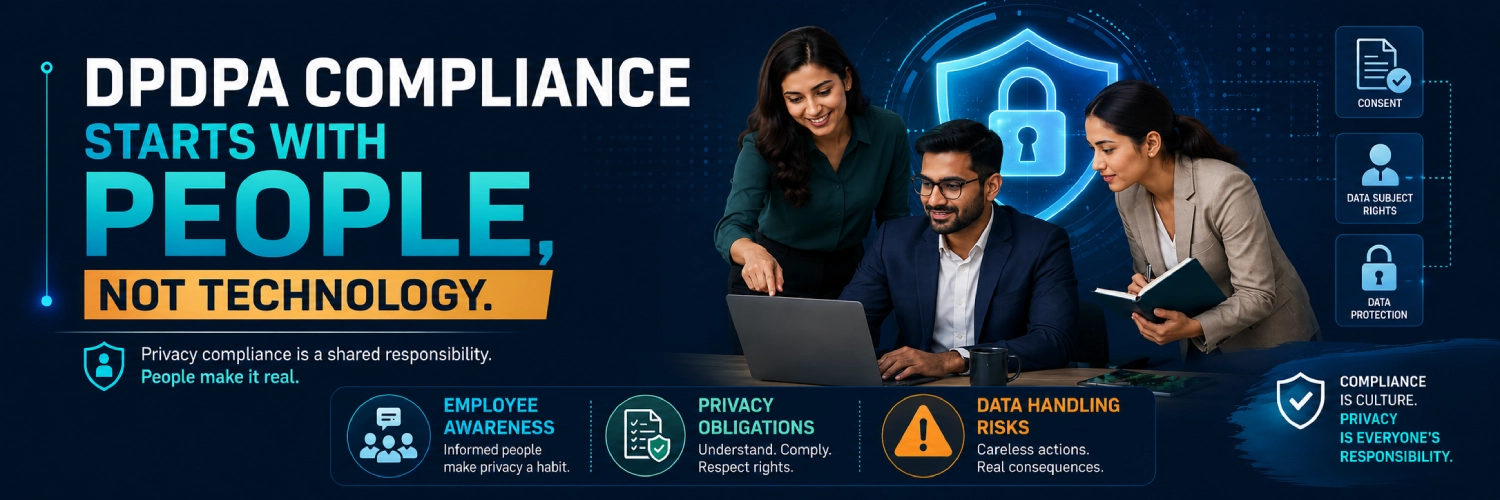
DPDPA Compliance Starts with People, Not Technology
When the conversation turns to India’s Digital Personal Data Protection Act, the instinct in most boardrooms is to reach for technology. Encrypt the databases. Buy the consent-management platform. Configure access controls. Commission a privacy dashboard. These are all sensible steps, and none of them should be skipped. But they share a common blind spot: they treat compliance as something you install rather than something you live.
The DPDP Act, with its rules finalized in November 2025 and full compliance expected by roughly mid-2027, carries serious weight, penalties of up to ₹250 crore for failing to maintain reasonable security safeguards and up to ₹200 crore for failing to report a breach. With stakes that high, it is tempting to believe the answer lies entirely in the right software. It does not. Real compliance starts with the people who handle personal data every single day, and no platform can substitute for that.
Technology Guards the Door. People Hold the Keys.
Consider how personal data actually moves through an organization. It is collected by a sales representative on a call. It is entered into a system by an operations clerk. It is exported into a spreadsheet by an analyst preparing a report. It is shared with a vendor by a procurement officer. It is discussed in an email thread, copied into a presentation, downloaded to a laptop for a client meeting. At every one of these moments, a human being is making a decision about data, and most of those decisions happen far from any security tool’s reach.
This is why technology alone falls short. Your encryption is excellent until an employee emails an unencrypted export to the wrong recipient. Your access controls are robust until someone with legitimate access is tricked into handing over their credentials. The reality reflected in the data is stark: roughly 60% of breaches involve a human element (Verizon 2025 DBIR). The door may be locked, but the people inside hold the keys, and attackers know exactly whom to ask.
The DPDP Act implicitly recognizes this by requiring not just technical measures but governance, the appointment of a Data Protection Officer, the running of Data Protection Impact Assessments, and regular audits. These are fundamentally about people understanding their obligations and acting on them. A DPIA is only as good as the awareness of those who fill it in. An audit only surfaces what people are actually doing.
The Everyday Habits That Make or Break Compliance
The privacy risks that lead to regulatory trouble are rarely dramatic. They are mundane, accumulating quietly through ordinary habits. An employee keeps a years-old customer list “just in case,” long after any lawful purpose has expired. Another shares login credentials with a colleague to save time. A manager forwards a file full of personal data to a personal email account to work on over the weekend. None of these feels like a breach in the moment. Each is a compliance failure waiting to surface.
Good data handling, by contrast, is a set of learned, reinforced habits:
1. Collecting only the personal data genuinely needed for a stated, lawful purpose, and no more.
2. Knowing where personal data lives and resisting the urge to copy it into informal, unprotected places.
3. Treating a data subject’s request, to access or delete their information, as a serious obligation, not an inconvenience.
4. Recognizing that a lost laptop, a misdirected email, or a successful phishing attack may constitute a reportable breach.
That last point deserves emphasis. Under the DPDP framework, all breaches must be reported irrespective of severity. That means an employee who quietly cleans up a mistake without telling anyone is not protecting the organization, they may be exposing it to the ₹200 crore penalty for failing to report. Your people need to understand that transparency, even about their own errors, is the compliant path. That is a cultural lesson, not a technical setting.
Why Awareness Is the Foundation, Not the Afterthought
If people are where compliance succeeds or fails, then employee awareness cannot be the final item on the implementation checklist. It has to be the foundation everything else rests on. A consent-management platform configured by staff who do not understand consent will be configured poorly. An incident-response plan no one has internalized will not be followed in the chaotic minutes after a breach.
There is also a harder problem to solve. Attackers increasingly target the human path to personal data directly, and they have become extraordinarily convincing. AI-generated phishing became the top enterprise email threat by late 2025, and AI scams surged 1,210% in 2025, with projected losses of around $40 billion by 2027. The phishing email designed to steal a database administrator’s credentials, or the deepfake voice call instructing a finance officer to share records, is now a routine threat. No consent tool defends against these. Only prepared, alert people do.
This is precisely why awareness must be continuous rather than a single onboarding session. Verizon’s 2025 research found that click and failure rates were largely unaffected by traditional one-off training. People who handle personal data need ongoing, realistic preparation that keeps pace with how attackers actually operate, not a one-time briefing they will have forgotten by the next quarter.
Building a Culture Where Privacy Is Everyone's Job
The organizations that will navigate DPDP compliance most gracefully are those that stop treating privacy as the legal team’s problem or the IT department’s project and start treating it as everyone’s job. This is a cultural shift more than a procedural one.
It means a sales team that understands why over-collecting customer data creates liability. It means engineers who think about data minimization when they design a feature. It means a customer-support agent who can recognize a social-engineering attempt aimed at extracting a customer’s personal information. When privacy thinking is distributed across the organization, compliance stops being a burden imposed from above and becomes the natural way work gets done.
Technology supports this culture, but it cannot create it. The platform enforces the rule; the person decides whether to honor the spirit behind it. And when regulators come to assess whether your safeguards were truly “reasonable,” a workforce that demonstrably understands and practices good data handling is among the most persuasive evidence you can offer.
Start Where the Risk Actually Lives
The path to DPDP readiness runs through your people first. The technology matters, the DPO matters, the DPIAs and audits matter, but all of them depend on a workforce that understands its obligations and behaves accordingly under real pressure. Compliance is ultimately a sum of countless small human decisions made correctly, day after day.
Conclusion
DPDPA compliance is not something you install; it is something your people live out at every point where personal data is collected, entered, shared, or stored. Encryption, consent platforms, and access controls are necessary, but they cannot decide for the human who emails the wrong file or trusts the wrong message. With roughly 60% of breaches involving a human element, awareness has to be the foundation rather than the final checklist item. Organizations that distribute privacy thinking across the workforce, and reinforce it continuously, are the ones best placed to demonstrate the “reasonable” safeguards the law expects.
How Shieldbyte Infosec Can Help
Shieldbyte Infosec’s ShieldPhish platform helps organizations build the human resilience that genuine DPDPA compliance requires. Through continuous, realistic phishing simulations, it teaches employees to recognize the social-engineering attacks that target personal data and the credentials guarding it. Human risk scoring shows precisely which roles and teams handle sensitive data with the most exposure, so training can be focused where it matters. Adaptive learning reinforces good data-handling habits over time rather than relying on a single onboarding session that fades. The platform’s reporting also gives leadership and DPOs defensible evidence of ongoing diligence. If your compliance program has leaned heavily on technology and lightly on people, we would welcome the chance to help you begin where the real risk lives.