



How One Employee Can Trigger a Regulatory Investigation
Every large compliance failure has a smaller story buried inside it, and that smaller story almost always involves a single person doing something that seemed, in the moment, entirely ordinary. Not a saboteur, not a criminal, just an employee at a desk, making a quick decision under the gentle pressure of a busy day. A click here, an approval there, a file sent to the wrong place. Hours or weeks later, that ordinary moment has become the opening line of a regulatory investigation.
It is a sobering thought for any leader: the gap between a routine Tuesday and a formal inquiry can be the width of one employee’s mistake. Understanding how that happens, and how to make it far less likely, is one of the most practical risk-reduction exercises a business can undertake.
The Anatomy of a Single Point of Failure
Picture a finance officer at a mid-sized company. An email arrives that appears to be from a senior executive, referencing a real project, written in a familiar tone, asking for an urgent payment to a new vendor account. The officer, wanting to be responsive and helpful, processes it. The money is gone before anyone realizes the email was fraudulent.
This is not a hypothetical pattern. The FBI’s IC3 2025 report attributed $3.046 billion in losses to business email compromise across 24,768 complaints, an average of around $123,000 per incident. Each of those complaints began with a person who trusted a message they should not have. And the attacks have grown more convincing. In one widely reported 2024 case, the engineering firm Arup lost $25 million after an employee was deceived by a deepfake video call impersonating the company’s CFO and colleagues. The employee was not careless in any ordinary sense. They were facing a fabricated reality of extraordinary quality.
The lesson is not that these employees were unusually fallible. It is that any organization is one convincing deception away from a serious incident, because the entire system can hinge on a single human decision at a single moment.
When a Mistake Becomes a Regulatory Matter
A financial loss is painful, but it is often the regulatory consequences that prove most damaging and longest-lasting. The moment that fraudulent payment also involved exposing personal data, or that misdirected file contained customer information, the incident crosses from a business problem into a compliance event.
Under India’s DPDP Act, the implications are significant. The framework requires that all breaches be reported irrespective of severity, with penalties of up to ₹200 crore for failing to report and up to ₹250 crore for failing to maintain reasonable security safeguards. This creates a crucial dynamic that every employee needs to understand: the instinct to quietly fix a mistake and avoid embarrassment is precisely the instinct that turns a manageable incident into a catastrophic one.
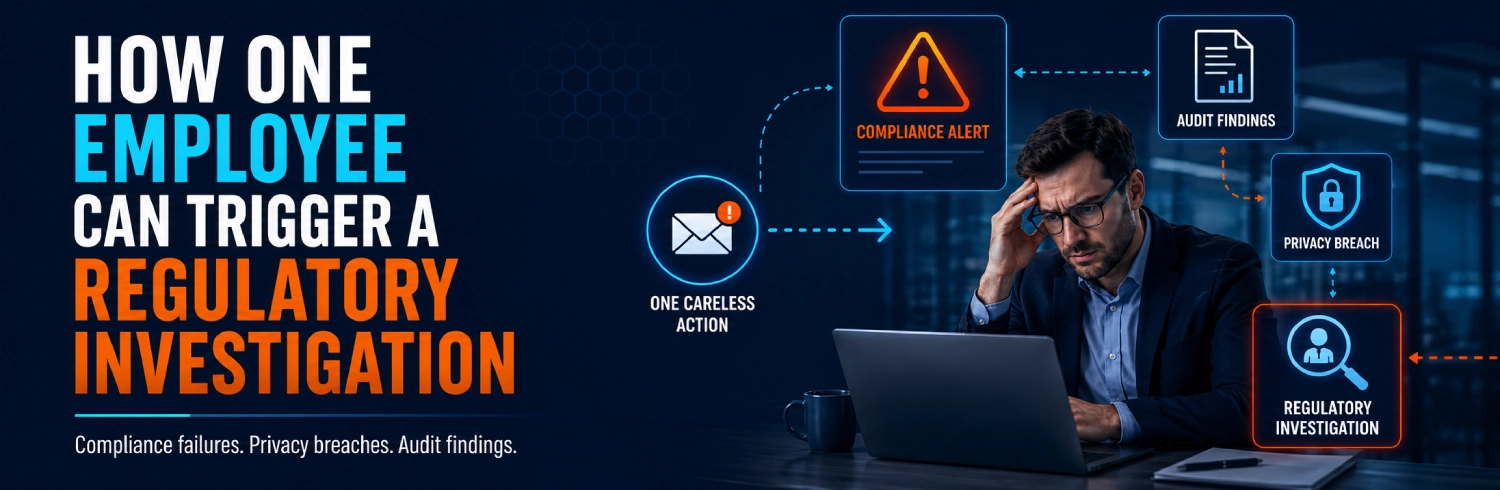
Consider how a single employee’s actions can cascade into an investigation:
1. The employee falls for a phishing attack, exposing a system containing personal data.
2. Unsure what to do, or hoping it will blow over, they delay reporting it internally.
3. The breach surfaces later, perhaps through a customer complaint or an external party.
4. Now the organization faces not only the breach itself but a failure-to-report exposure, and regulators arrive asking why safeguards and processes did not catch any of it.
What began as one person’s clickable mistake has become an examination of the entire organization’s governance.
What Investigators Actually Look For
When a regulator opens an inquiry, they are rarely satisfied by punishing the individual who made the error. Their attention turns quickly to the system around that person. Were there reasonable safeguards in place? Was there evidence of genuine, ongoing preparation, or merely a dusty annual training record? Was there a Data Protection Officer, were Data Protection Impact Assessments conducted, were audits performed, all of which the DPDP framework expects?
This is where many organizations discover an uncomfortable truth. They can produce a certificate showing that the employee completed security training eleven months ago. What they cannot produce is evidence that the training actually built resilience. Verizon’s 2025 research found that click and failure rates were largely unaffected by traditional one-off training, which means a completion record is increasingly weak evidence of diligence. An investigator reasonably asks: if your training did not change behavior, in what sense were your safeguards reasonable?
The most defensible position is one where the organization can show a living, continuous program, regular realistic testing, measurable improvement in how people respond, and prompt internal reporting culture. That is the difference between “we told them once” and “we genuinely prepared them and can prove it.”
The Conditions That Turn People Into Liabilities
It is worth being honest about why good employees make bad decisions, because the conditions are usually environmental rather than personal. People are rushed. They are trained to be helpful and responsive, which attackers exploit. They face attacks of unprecedented sophistication, AI-generated phishing became the top enterprise email threat by late 2025, and they often do not feel safe admitting mistakes.
That final condition is the quiet multiplier. In a culture where errors are punished harshly, people hide them, and hidden breaches are exactly what regulators penalize most severely. In a culture where reporting is encouraged and rewarded, problems surface early, when they can still be contained and properly disclosed. The same human being can be a liability or an asset depending almost entirely on the environment the organization has built around them.
This means reducing your exposure to a single-employee-triggered investigation is partly about preparation and partly about psychological safety. People need both the skill to recognize threats and the confidence to raise a hand the instant something goes wrong.
Turning Your Greatest Risk Into Your Strongest Defense
The same employee who can trigger an investigation can also prevent one. The finance officer who pauses and verifies the unusual payment request. The clerk who recognizes the deepfake’s subtle wrongness. The analyst who reports a suspicious email within minutes rather than hours. Across the same set of people, the difference between vulnerability and protection is preparation and culture, nothing more exotic than that.
That is why the smartest response to this risk is not to bolt on more technology and hope, but to invest steadily in the people who stand at every decision point. Continuous, realistic preparation turns “the weakest link” into a vigilant, responsive line of defense, and it gives you something genuinely valuable if scrutiny ever comes: proof that you took the human element as seriously as it deserves.
Conclusion
The distance between a routine workday and a formal regulatory inquiry can be as narrow as one employee’s mistake. As business email compromise losses and deepfake-enabled scams show, even careful, well-meaning staff can be deceived by attacks of extraordinary quality, and a delayed or hidden report can turn a contained incident into a catastrophic one. Regulators look past the individual to the system: whether reasonable safeguards existed, whether preparation was genuine and ongoing, and whether reporting culture was healthy. The same employee who can trigger an investigation can just as easily prevent one, given the right preparation and a culture that rewards raising a hand early.
How Shieldbyte Infosec Can Help
Shieldbyte Infosec’s ShieldPhish platform is built to shrink the gap between a single mistake and a serious incident. Continuous phishing simulations prepare people for the convincing, multi-channel deceptions they will actually face, from impersonated executives to fraudulent payment requests. Human risk scoring pinpoints the high-exposure roles, such as finance and operations, where a single decision carries outsized consequences, so attention goes where it counts. Adaptive training reinforces both the skill to spot threats and the instinct to report them immediately, fostering the psychological safety that surfaces problems early. Detailed reporting gives leadership defensible evidence that the human element was taken seriously. If you have ever wondered how close your business sits to a one-employee incident, we would be glad to help you answer that before a regulator asks it for you.