



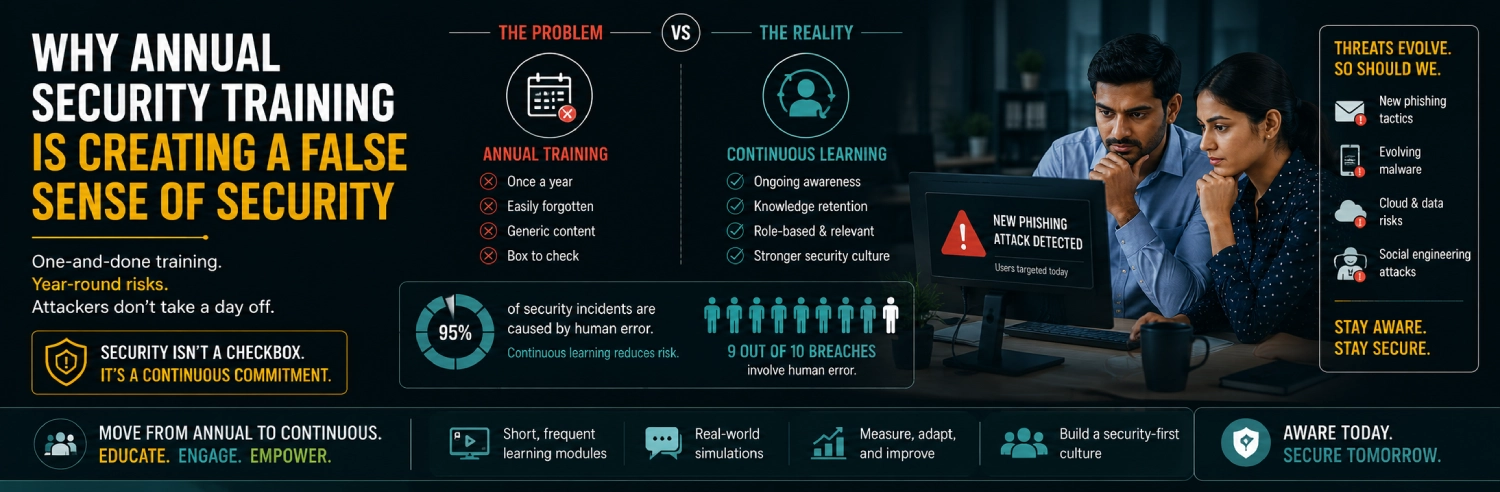
Why Annual Security Training Is Creating a False Sense of Security
There is a particular kind of comfort that comes from completing a task you believe protects you. When an organization finishes its annual security training, when the last employee clicks through the final slide and the completion report shows a satisfying row of green ticks, there is a collective exhale. The job is done for another year. The business feels safer.
That feeling is the problem. Because in too many organizations, the sense of security that annual training provides has grown disconnected from the actual security it delivers. The comfort is real; the protection, increasingly, is not. And a false sense of security is arguably more dangerous than no sense of security at all, because it stops you looking for the gaps you assume you have already closed.
The Comfort of the Completion Report
It is easy to see why the annual model became the default. It is tidy. It aligns with audit cycles. It produces a clean artifact, a completion record, that can be shown to auditors, boards, and regulators. It feels like diligence, and for a long time everyone agreed to treat it as such.
But a completion report measures the wrong thing. It tells you that an employee sat through a module and passed a quiz on a given day. It tells you nothing about whether that person would resist a sophisticated attack three months later, on a hectic afternoon, when the lure is well-crafted and the timing is cruel. We have confused the evidence of activity with the evidence of capability, and the two are not the same.
The most direct challenge to the annual model comes from the data itself. Verizon’s 2025 Data Breach Investigations Report found that click and failure rates were largely unaffected by traditional one-off training. Read that plainly: the central thing the annual session is supposed to achieve, making people less likely to fall for attacks, is not reliably happening. The green ticks are real. The reduced risk they imply may be an illusion.
Why Knowledge Fades and Threats Do Not Wait
Two forces work against the annual model, and they push in opposite directions, which makes the gap between them widen over the year.
The first is the simple reality of human memory. Knowledge delivered in a single concentrated session fades steadily. What an employee learns in a January training is sharp in February and hazy by September. We have known this about learning for over a century, yet we keep designing security programs as if a once-yearly download will stick. It will not. Skills that are not practiced and reinforced decay, and recognizing a phishing attempt is a skill, not a fact.
The second force is the relentless evolution of the threats themselves. While your employees’ knowledge fades, attackers improve. AI-generated phishing became the top enterprise email threat by late 2025. AI scams surged 1,210% in 2025. Vishing, voice-based phishing, rose 442% in the same year. Quishing, attacks using QR codes, grew more than 400% between 2023 and 2025. The very nature of the threat changes faster than your annual cycle can possibly accommodate. Training someone in January for the threats of January leaves them facing the threats of December with a year-old map.
Put these together and the picture is clear. Over the twelve months between sessions, employee readiness drops while attacker capability climbs. The annual model guarantees that the gap between what your people can handle and what they will actually face is at its widest precisely when you have stopped paying attention.
The Hidden Cost of Believing You Are Covered
A false sense of security carries a cost that goes beyond the obvious. When leaders believe the human risk has been handled by the annual program, they stop scrutinizing it. Budget gets allocated elsewhere. The uncomfortable question, are our people actually getting better at resisting attacks?, never gets asked, because everyone assumes the answer is yes.
Meanwhile the financial stakes have never been higher. IBM’s 2025 Cost of a Data Breach report put the global average breach cost at $4.44 million, with the US average reaching an all-time high of $10.22 million. The FBI’s IC3 2025 report recorded $20.877 billion in total US cybercrime losses, up 26% year over year. These are not the numbers of a problem that has been solved by an annual slide deck. They are the numbers of a problem that is accelerating while many organizations look the other way, reassured by their completion records.
The false sense of security also creates a brittle culture. When the program is treated as a once-a-year obligation, employees absorb the message that security is a compliance chore rather than a continuous shared responsibility. They click through, they forget, and they carry no real expectation of vigilance into their daily work.
What Continuous Learning Looks Like in Practice
The alternative is not simply “more training,” which would only mean more of the same chore delivered more often. The alternative is a fundamentally different rhythm, one where preparation is woven into the flow of work rather than dropped on it once a year.
Continuous learning looks like short, frequent touchpoints rather than one long event. It looks like realistic simulations spread across the year, so that recognizing a threat becomes a practiced reflex rather than a recalled fact. It looks like learning that responds to behavior, when an employee struggles with a particular type of lure, they receive targeted reinforcement, not the same generic module everyone else gets. And it looks like preparation that stays current, addressing the deepfake voice call and the QR-code scam this quarter rather than the email scams of two years ago.
This approach matters all the more because attacks are now multi-channel, 41% of phishing incidents combine email, SMS, QR codes, and voice. Defending against a moving, multi-front threat requires people whose readiness is continuously maintained, not topped up once and left to drain.
Trading Comfort for Genuine Confidence
The hardest part of moving beyond annual training is letting go of the comfort it provides. The completion report feels good. Continuous measurement, by contrast, will sometimes show you uncomfortable truths, that a department is more susceptible than you hoped, that progress is slower than you assumed. But that discomfort is the sound of real risk being surfaced and addressed, rather than hidden behind a tidy artifact.
Genuine confidence does not come from a certificate filed once a year. It comes from being able to look at your organization and say, truthfully, that your people are measurably more resilient this quarter than they were last quarter, and that you have the evidence to prove it. That is worth far more than the fleeting reassurance of a finished module.
Conclusion
Annual security training offers comfort, but comfort is not the same as protection, and a false sense of security can be more dangerous than none at all. Knowledge from a single session fades over the year while attacks, increasingly AI-generated and multi-channel, only grow sharper, widening the gap precisely when no one is watching. Completion reports measure activity, not capability, and the documented reality is that one-off training leaves click and failure rates largely unchanged. The alternative is not more of the same chore delivered more often, but a different rhythm of short, frequent, behavior-driven practice that keeps readiness continuously maintained.
How Shieldbyte Infosec Can Help
Shieldbyte Infosec’s ShieldPhish platform helps organizations trade the false comfort of annual training for the genuine confidence of continuous learning. Rather than one long event, it delivers frequent, realistic phishing simulations across email, SMS, QR codes, and voice, so recognizing a threat becomes a practiced reflex that stays current with how attacks evolve. Human risk scoring reveals where susceptibility is rising, and adaptive training responds with targeted reinforcement for the people and lures that need it most, rather than the same generic module for everyone. Leadership reporting shows resilience trending quarter over quarter, surfacing the uncomfortable truths a completion certificate hides. If your security program has been built around a yearly ritual, we would be glad to help you discover what it is actually achieving in the long months between.