



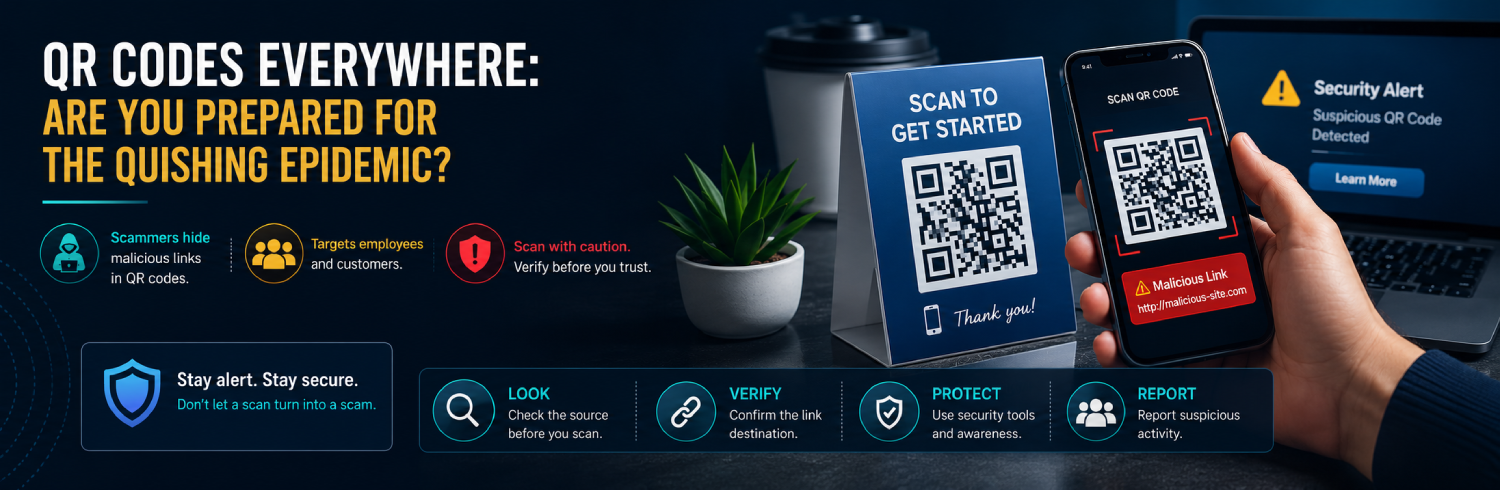
QR Codes Everywhere: Are You Prepared for the Quishing Epidemic?
Walk into almost any restaurant, parking lot, or conference hall today and you will be invited to point your phone at a small black-and-white square. QR codes have quietly become part of how we pay bills, view menus, board flights, and join networks. They are convenient, contactless, and trusted. And that trust is exactly what makes them dangerous. A new wave of attacks known as “quishing” — QR-code phishing — has turned this everyday convenience into one of the fastest-growing threats facing businesses and their customers. The question for every decision-maker is no longer whether your people will encounter a malicious QR code, but whether they will recognize it when they do.
A Familiar Square With a Hidden Agenda
The appeal of quishing to attackers is almost embarrassingly simple. A QR code is an image, not a clickable link. That means it slides past many of the email security filters that have spent years learning to spot suspicious URLs. When an employee receives an email asking them to scan a code to “reactivate their account” or “review a shared document,” the message often looks clean to automated defenses because the malicious destination is hidden inside a picture.
The scale of the shift has been striking. In 2025, roughly 12% of phishing attacks contained a QR code, an increase of more than 400% since 2023. The volume of QR-phishing emails alone surged from around 46,000 in August to roughly 250,000 by November of 2025. Around 90% of these attacks were designed to do one thing: steal login credentials, usually by sending the victim to a convincing fake login page. Once an attacker holds a valid username and password, they hold a key to your systems, your data, and often your customers’ data too.
Why Your Phone Is the Weak Link
There is a reason 68% of quishing attacks specifically target mobile devices. When you scan a code, the action moves from a managed corporate laptop — with its firewalls, monitoring, and security software — to a personal or mobile phone that frequently sits outside the organization’s protective bubble. On a small screen, a shortened or disguised web address is hard to read. The browser bar is tiny, the page loads quickly, and muscle memory takes over. People are conditioned to scan and proceed, not to scan and scrutinize.
This is what makes quishing such an effective bridge into the broader world of multi-channel attacks. An email lands in a work inbox, but the trap springs on a phone, in a different app, away from corporate oversight. It is no coincidence that 41% of phishing incidents are now multi-channel, combining email, SMS, QR, and voice. Quishing thrives precisely because it exploits the seam between the devices we protect and the devices we carry everywhere.
Where the Codes Are Hiding
Part of preparing your organization is helping people picture where these attacks actually appear, because they are rarely confined to email. Attackers have grown creative about placing codes wherever a moment of trust exists.
1. Printed flyers, fake parking-meter stickers, and tampered posters in public spaces, where a fraudulent code is physically pasted over a legitimate one.
2. Invoices and shipping notifications that ask the recipient to scan to “confirm payment” or “track a delivery.”
3. Emails impersonating IT, HR, or a payroll provider, prompting staff to scan to “verify identity” or “update benefits.”
4. Customer-facing touchpoints — your own branding can be copied onto a fake code that redirects your customers to a counterfeit site, damaging trust you spent years building.
The common thread is that the code arrives in a context where scanning feels routine and reasonable. That is the attacker’s craft: not to alarm you, but to blend in.
The Cost of a Single Scan
It can be tempting to treat a QR scam as a minor nuisance, but the downstream consequences scale quickly. A stolen credential can open the door to business email compromise, fraudulent fund transfers, or a full data breach. The numbers behind these outcomes are sobering. The global average cost of a data breach reached $4.44 million in 2025, with the US average hitting an all-time high of $10.22 million (IBM 2025 Cost of a Data Breach). Around 60% of breaches involve a human element (Verizon 2025 DBIR) — and a person scanning a code is about as human an element as it gets.
For organizations operating in India, there is a regulatory dimension as well. With the DPDP Act Rules finalized in November 2025 and full compliance expected by around mid-2027, businesses face penalties of up to ₹250 crore for failing to maintain reasonable security safeguards and up to ₹200 crore for failing to report a breach. A successful quishing campaign that exposes personal data is not just an operational problem; it can become a compliance and reputational one.
Building a Workforce That Pauses Before It Scans
The encouraging news is that quishing is highly defensible once people understand it. The defense is partly technical — modern email security that inspects images, mobile device management, and strong multi-factor authentication that resists credential theft. But the most powerful control is a workforce that has internalized a simple habit: pause before you scan, especially when a code arrives unexpectedly or carries a sense of urgency.
That habit does not come from a single annual training video. Verizon’s 2025 research found that click and failure rates were largely unaffected by traditional one-off training. People learn to resist these attacks the same way they learn anything else — through realistic, repeated practice. When employees occasionally encounter a safe simulated quishing attempt and get gentle, immediate coaching, the behavior sticks. They begin to notice the small inconsistencies: the unexpected request, the slightly-off sender, the code where a normal link should be.
Conclusion
Quishing succeeds because it hides a malicious link inside a trusted, everyday image and springs its trap on the mobile devices we guard the least. The data shows the threat is rising sharply, and a single scan can cascade into credential theft, business email compromise, and a costly breach. Technical controls matter, but the most durable defense is a workforce that has built the instinct to pause before it scans. QR codes are not going away — they are too useful for that. The organizations that thrive will be the ones whose teams can enjoy the convenience without inheriting the risk.
How Shieldbyte Infosec Can Help
Shieldbyte Infosec’s ShieldPhish platform is built to develop exactly the instinct that defeats quishing. By running realistic QR-code and multi-channel phishing simulations, ShieldPhish lets your people safely experience the attacks they will face in the real world. Each teachable moment becomes a short, supportive coaching nudge rather than a reprimand, so the behavior sticks. ShieldPhish also measures human risk across teams and individuals, helping you see who needs more practice and how that risk changes over time. Adaptive training then focuses effort where it matters most, while clear reporting gives leadership a defensible view of workforce resilience. If you are ready to see how prepared your people really are, that is a conversation worth starting.