



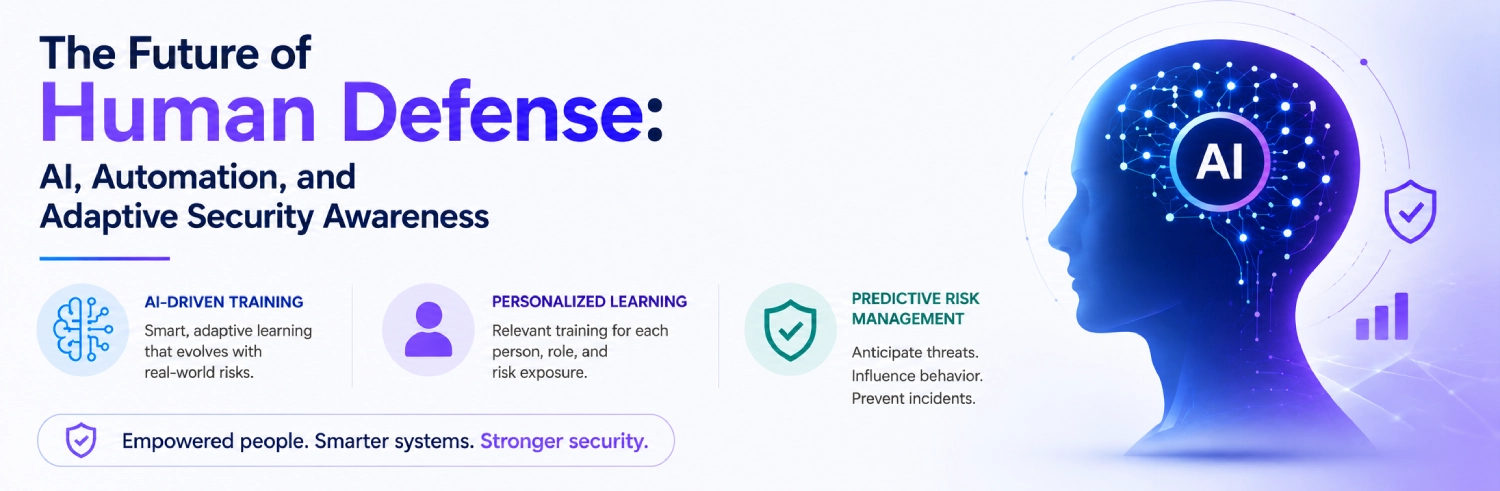
The Future of Human Defense: AI, Automation, and Adaptive Security Awareness
For most of its history, security awareness training has been static. An organization would choose a set of lessons, deliver them to everyone in the same way, and repeat the exercise once a year. Every employee, regardless of their role, their risk, or their past behavior, received the identical experience. That approach is now reaching the end of its usefulness, not because the idea of training people was wrong, but because the world it was designed for no longer exists. Attackers have embraced artificial intelligence to make their deceptions faster, cheaper, and dramatically more convincing. The defense has to evolve in the same direction, and it is beginning to. The future of human defense is adaptive, personalized, and intelligent.
The Attackers Already Upgraded
It is impossible to talk about the future of defense without acknowledging what has happened on the other side. Attackers have undergone a transformation, and the numbers are difficult to ignore. AI scams surged 1,210% in 2025, with projected losses reaching around $40 billion by 2027, and AI-generated phishing became the top enterprise email threat by late 2025 (industry data).
The effectiveness of these attacks is what makes them so dangerous. AI-written phishing emails saw roughly 54% click-through compared with about 12% for traditional phishing, nearly four and a half times higher (Brightside AI study). Deepfakes have followed the same trajectory, with deepfake files growing from around 500,000 in 2023 to roughly 8 million in 2025 and deepfake video scams rising 700% in 2025 (industry data). The Arup case, in which the firm lost $25 million to a deepfake video call impersonating its CFO and colleagues (2024), is no longer a hypothetical warning. It is a documented event.
The lesson is stark. If attackers are using intelligent, adaptive tools and defenders are still using static annual videos, the contest is profoundly uneven.
Why One-Size-Fits-All Training Is Ending
The traditional model fails for a reason that has nothing to do with effort and everything to do with design. Treating every employee identically ignores the fact that risk is not distributed evenly across an organization. A finance executive who approves large payments faces a different threat profile than a warehouse coordinator. A new hire who has never seen a simulation needs different support than a veteran who reports suspicious emails reliably.
Static training cannot account for these differences, which is part of why Verizon found that click and failure rates were largely unaffected by traditional one-off training (Verizon 2025 DBIR). It delivers the same lesson to someone who has already mastered it and to someone who is dangerously unprepared, and in doing so it serves neither well. The future belongs to approaches that recognize people as individuals with distinct roles, histories, and vulnerabilities.
What Adaptive, Personalized Learning Looks Like
The promising shift underway is toward learning that adapts to the individual. Rather than delivering identical content to everyone, adaptive systems use intelligence to tailor the experience to each person’s actual behavior and risk.
In practice, this means several things working together:
1. Simulations that adjust in difficulty based on how an individual has performed, challenging those who are ready and supporting those who need reinforcement.
2. Content that reflects a person’s specific role and the threats most relevant to it, so a finance team practices against invoice fraud while others train against the lures they are most likely to encounter.
3. Timing that responds to behavior, offering a brief, relevant lesson in the moment a risky action occurs rather than months later in an unrelated session.
This is a fundamentally more human way to teach. It mirrors how good mentors work, meeting each person where they are rather than treating everyone as interchangeable. The result is practice that feels relevant, which is precisely the kind of practice that builds lasting instinct.
From Reacting to Predicting
The deeper promise of intelligent defense is the move from reacting to predicting. Traditional security responds after something has gone wrong. The future is increasingly about identifying risk before it turns into an incident.
Predictive risk management uses patterns in behavior to anticipate where the next problem is most likely to emerge. It can highlight which individuals or teams are most vulnerable to a particular kind of attack, allowing an organization to focus its attention where it will do the most good rather than spreading effort evenly and thinly. This is not about surveillance or judgment; it is about directing care intelligently.
The financial logic is compelling. The IBM 2025 Cost of a Data Breach report found that organizations using AI and automation in their security saved roughly $1.9 million per breach (IBM 2025 Cost of a Data Breach). Much of that saving comes from anticipating and containing problems faster, which is exactly what a predictive, adaptive approach makes possible. Spotting the weak point before an attacker does is far cheaper than cleaning up afterward.
Keeping the Human at the Center
It would be a mistake to read this future as one in which technology replaces human judgment. The opposite is true. The goal of AI and automation in security awareness is not to remove people from the equation but to make them stronger. The technology handles the work of personalizing, timing, and predicting, so that the irreplaceable human qualities of judgment, skepticism, and care can be developed where they matter most.
This balance also intersects with a maturing regulatory landscape. India’s DPDP Act, with rules finalized in November 2025 and full compliance expected by around mid-2027, requires reasonable security safeguards, breach reporting, and the appointment of a Data Protection Officer along with impact assessments and audits (India DPDP Act). Adaptive, intelligent awareness programs help organizations meet these expectations not by replacing human accountability but by supporting it, ensuring that the people responsible for protecting data are genuinely equipped to do so.
Building the Human Defense of Tomorrow
The future of human defense is already taking shape, and it is intelligent, personalized, and adaptive. As attackers wield AI to make their deceptions more convincing than ever, the organizations that thrive will be those that wield the same intelligence to make their people more capable than ever. Technology will keep advancing on both sides of the contest, and the people at the center of the defense are what tip the balance.
Conclusion
Static, one-size-fits-all training was designed for a world that no longer exists. Attackers have embraced AI to make their deceptions faster, cheaper, and far more convincing, and the defense has to evolve in the same direction. The future of human defense is adaptive, personalized, and increasingly predictive, tailoring practice to each person’s role and behavior and directing attention to risk before it becomes an incident. Crucially, this is not about replacing human judgment but about making it stronger, keeping skepticism and care at the center of the defense.
How Shieldbyte Infosec Can Help
Shieldbyte Infosec built ShieldPhish for this future. The platform delivers continuous phishing simulation that adapts in difficulty to each employee’s performance, challenging those who are ready and reinforcing those who need support. Human-risk scoring identifies where vulnerability concentrates, allowing the program to focus effort where it will do the most good rather than spreading it evenly and thinly. Adaptive training reflects each person’s role and the threats most relevant to it, so finance teams practice against invoice fraud while others train on the lures they are most likely to meet. Reporting gives leadership a clear, current view of human risk and how it is changing, while keeping people firmly at the center of the defense. If you are thinking about what your human defense should look like in the years ahead, that future is well worth preparing for today.