



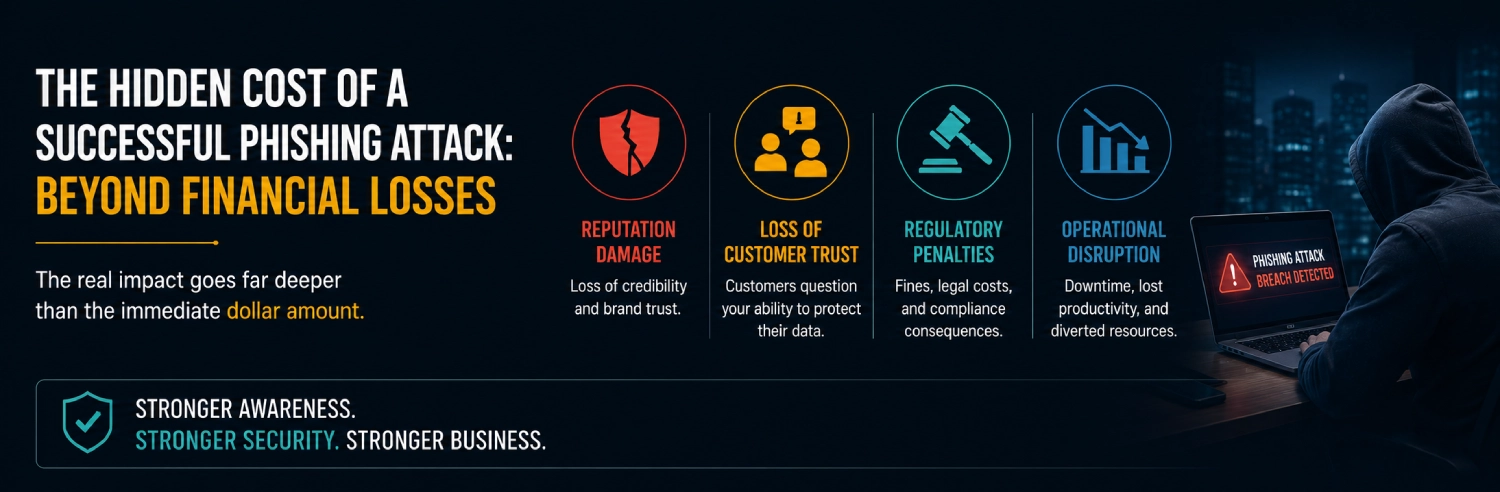
The Hidden Cost of a Successful Phishing Attack: Beyond Financial Losses
When a phishing attack succeeds, the first number anyone reaches for is the dollar figure. How much was wired to the wrong account? How much will recovery cost? These questions are urgent and important, but they capture only the surface of the damage. The truly lasting harm from a successful attack rarely appears on the initial invoice. It accumulates quietly over the following months in the form of eroded trust, regulatory scrutiny, distracted leadership, and a workforce that suddenly feels less sure of itself. Understanding these hidden costs is what separates organizations that merely survive an incident from those that learn to prevent the next one.
The Financial Number Is Only the Headline
It is worth acknowledging the visible cost, because it is substantial. The IBM 2025 Cost of a Data Breach report put the global average breach at $4.44 million, with the United States average reaching an all-time high of $10.22 million (IBM 2025 Cost of a Data Breach). Business email compromise alone drove $3.046 billion in losses across nearly 25,000 complaints in a single year, and total reported US cybercrime losses reached $20.877 billion, up 26% year over year (FBI IC3 2025).
These figures are sobering, but they describe the immediate, measurable hit. They do not capture what happens to a business in the weeks and quarters that follow, when the wire has already left and the real reckoning begins. The headline number is the part of the iceberg above the waterline.
When Customers Quietly Walk Away
The most corrosive cost of a phishing breach is the one that never sends an invoice: the loss of trust. Customers hand over their data on the implicit promise that you will protect it. When that promise is broken, the relationship changes, often permanently and often silently.
People rarely announce that they are leaving because of a breach. They simply renew less often, recommend you less enthusiastically, and hesitate before sharing information they once provided freely. Prospects who were close to signing pause and reconsider. The damage shows up not as a dramatic exodus but as a slow softening of the numbers that took years to build.
This erosion is especially painful because it strikes at the foundation of why customers chose you in the first place. A competitor can match your pricing or your features, but rebuilding a reputation for trustworthiness takes far longer than losing it. The cost is real even though it never appears as a line item.
The Regulatory Reckoning
Where customer trust erodes quietly, regulators act in writing. Privacy law has matured to the point where a breach is no longer simply a private misfortune; it is a reportable event with defined consequences.
India’s DPDP Act makes this explicit. With rules finalized in November 2025 and full compliance expected by around mid-2027, the law requires that all breaches be reported and that organizations maintain reasonable security safeguards. The penalties are significant: up to ₹250 crore for failing to maintain those safeguards and up to ₹200 crore for failing to report a breach (India DPDP Act). The Act also requires a Data Protection Officer, data protection impact assessments, and audits, which means a single phishing incident can trigger a cascade of obligations, scrutiny, and documentation long after the initial event.
For decision-makers, the lesson is that the cost of a breach is increasingly set not only by attackers but by regulators. The phishing email that compromises a single account can ultimately expose the organization to penalties that dwarf the original fraud.
The Internal Toll Nobody Budgets For
There is a third category of cost that is almost never anticipated: the human and operational drain inside the organization itself. After a breach, leadership attention is consumed by investigation, communication, legal review, and remediation. Projects stall. The teams responsible for the breach response are pulled away from the work that actually moves the business forward.
Then there is the effect on morale. The employee who clicked the link often carries a quiet sense of guilt, and colleagues can become so anxious about making a similar mistake that they second-guess routine decisions. A culture of fear is not a culture of security. It slows people down without making them safer, and it can linger far longer than the technical cleanup.
This internal toll is harder to quantify than a wire transfer, but it is no less real. The hours spent on recovery are hours not spent on growth, and the confidence lost is confidence that must be deliberately rebuilt.
Why Prevention Is the Real Bargain
When you add the visible losses, the quiet erosion of trust, the regulatory exposure, and the internal drain together, the full cost of a successful phishing attack is far larger than the initial figure suggests. This is what makes prevention such a clear bargain by comparison.
It is also why one-off training is no longer enough. Verizon found that click and failure rates were largely unaffected by traditional one-off training (Verizon 2025 DBIR), which means a single annual session does little to change the behavior that drives most breaches. What works is ongoing, realistic practice that builds genuine instinct over time. Encouragingly, organizations that invested in AI and automation in their security saved roughly $1.9 million per breach (IBM 2025 Cost of a Data Breach), evidence that smarter, continuous defense pays for itself.
Protecting What You Cannot Easily Rebuild
The hardest costs to recover from a phishing attack are not the ones on the balance sheet. They are the trust your customers placed in you, the confidence your team had in itself, and the reputation you spent years earning. These are precisely the things that prevention protects and that no recovery budget can fully restore.
Conclusion
The dollar figure that follows a phishing attack is only the headline; the lasting damage accumulates quietly in eroded customer trust, regulatory exposure, and an internal drain on attention and morale. When those hidden costs are added to the visible ones, prevention reveals itself as the clear bargain. Because one-off training does little to change the behavior behind most breaches, the real answer is ongoing, realistic practice that builds genuine instinct over time. The cheapest breach, after all, is the one that never happens.
How Shieldbyte Infosec Can Help
Shieldbyte Infosec built ShieldPhish around the understanding that the costliest damage is the hardest to rebuild. The platform helps organizations turn their people into a confident, well-practiced line of defense through continuous phishing simulation rather than a single annual session. Human-risk scoring shows where exposure actually concentrates, while adaptive training meets each employee at their level and reinforces the right instincts over time. Clear reporting gives leadership the evidence to see how resilience is improving and where attention is still needed. By addressing the root cause before the hidden costs can accumulate, it helps protect what you cannot easily rebuild. If that matters to your organization, it is a conversation worth starting.