



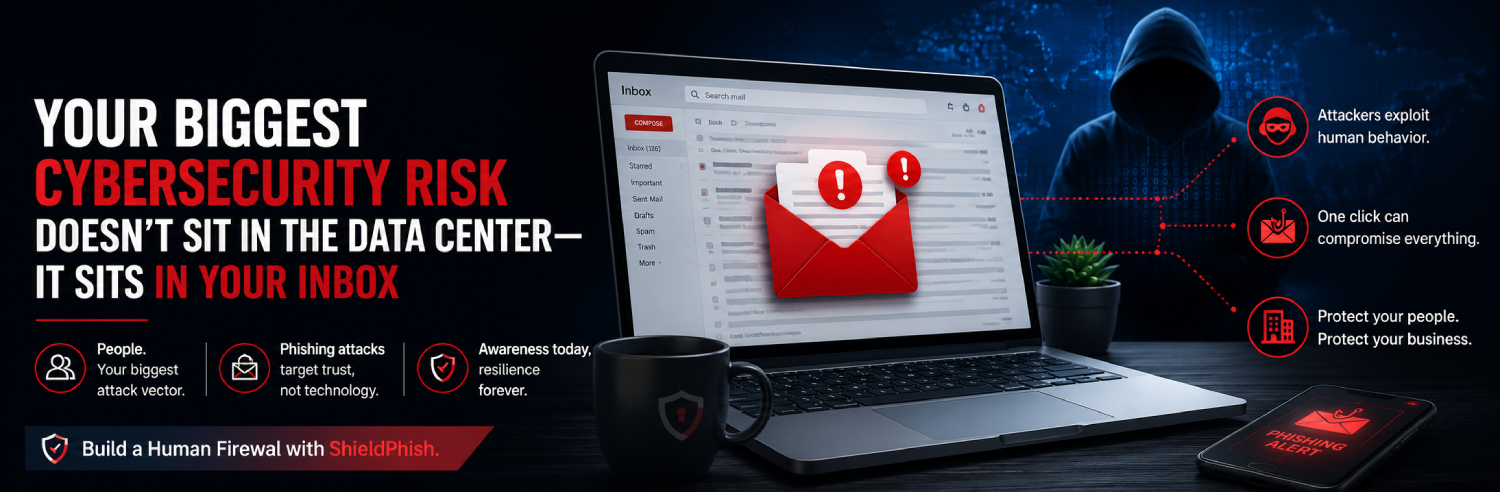
Your Biggest Cybersecurity Risk Doesn't Sit in the Data Center - It Sits in Your Inbox
When most leaders picture a cyberattack, they imagine something cinematic: a hooded figure cracking through firewalls, lines of green code scrolling across a screen, a server room under siege. So that is where the money goes. Organizations invest heavily in next-generation firewalls, endpoint detection, encrypted storage, and round-the-clock monitoring. All of that matters. But it quietly misreads where the real danger lives. The most exploited entry point into your business is not a misconfigured server or an unpatched router. It is the ordinary inbox sitting open on a colleague’s laptop right now.
The data is unambiguous. According to the Verizon 2025 Data Breach Investigations Report, roughly 60% of breaches involve a human element—a person clicking, approving, sharing, or trusting something they should not have. Attackers have figured out what defenders are slow to accept: it is far easier to deceive a busy human than to defeat a well-built machine. Why spend weeks probing technical defenses when a single convincing email can hand you the keys?
The Front Door Everyone Forgets to Lock
Email remains the most reliable way into an organization, and phishing is the crowbar. The Verizon 2025 DBIR found that 16% of breaches began with phishing, and phishing accounted for roughly 14% of all breach action varieties. Those numbers sound modest until you sit with what they represent: nearly one in six serious security incidents starts with someone receiving a message designed to look legitimate—and believing it.
What makes the inbox such a soft target is not that employees are careless. It is that the inbox is where work actually happens. Invoices arrive there. So do password reset links, calendar invites, contracts, requests from the boss, and messages from vendors. The very thing that makes email indispensable—its role as the connective tissue of business—is what makes it dangerous. A malicious message does not have to break anything. It only has to blend in.
And attackers have become extraordinary at blending in. A modern phishing email may carry your company logo, reference a real project, spoof a colleague’s name, and arrive at a plausible moment in the workday. The recipient is not being foolish. They are being human, processing dozens of messages under time pressure, pattern-matching against what looks normal. The attacker’s entire craft is to look normal.
Why "Just Train Them More" Has Stopped Working
For two decades, the standard answer to this problem has been awareness training. Sit everyone down once a year, show them a slide deck about suspicious links, have them pass a quiz, and move on. It feels responsible. It checks a compliance box. The trouble is that it does not appear to change behavior in any lasting way.
The Verizon 2025 DBIR delivered an uncomfortable finding here: click and failure rates were largely unaffected by traditional one-off training. People sat through the session, nodded along, and then clicked the next convincing email anyway. This should not surprise us. We do not learn to drive safely by watching one video a year. We learn through repetition, feedback, and practice that mirrors real conditions.
One-off training fails for a few clear reasons:
a) It treats security as a knowledge problem when it is really a behavior problem. People often know not to click and click anyway.
b) It is forgotten quickly, while attacks arrive constantly and evolve weekly.
c) It is generic, while real attacks are increasingly tailored to the individual, their role, and their moment.
The takeaway is not that training is worthless. It is that training as a once-a-year event, disconnected from how people actually work, has reached the limits of what it can do.
The Human Element Is Not a Weakness to Eliminate
It is tempting to conclude that people are the problem and to treat them accordingly—with more rules, more blocking, more suspicion. That instinct backfires. Employees who feel policed tend to hide their mistakes, and a hidden mistake is far more dangerous than a reported one. The person who clicks a bad link and immediately tells someone has given you a chance to contain the damage. The person who clicks and stays silent out of fear has handed the attacker time.
A healthier frame is to see your people as the largest, most distributed sensor network you own. Every employee touches email, messages, and requests all day long. With the right support, that vast surface area becomes a strength rather than a liability. The goal is not to eliminate the human element. It is to manage it—to make good security behavior the easy, natural, well-supported default.
That shift in mindset matters especially for leaders operating under tightening regulation. India’s Digital Personal Data Protection Act, with rules finalized in November 2025 and full compliance expected by around mid-2027, raises the stakes considerably. Penalties can reach ₹250 crore for failing to maintain reasonable security safeguards and ₹200 crore for failing to report a breach, and every breach must now be reported. When a single deceived employee can trigger an incident that demands disclosure and invites scrutiny, the inbox stops being an IT concern and becomes a board-level one.
What Managing Inbox Risk Actually Looks Like
If annual training is not enough, what replaces it? The answer is a continuous, measurable approach to human risk—one that treats employee behavior the way you treat any other operational risk you would never set and forget.
In practice, that means moving from awareness to evidence. Instead of asking “did everyone attend the session,” you start asking better questions: Which teams are most likely to click? Which kinds of lures succeed against us? Is our risk going up or down over time? Realistic phishing simulations, delivered regularly and varied to match current attacker tactics, give you those answers. They turn a vague worry into a number you can track and improve.
Crucially, this approach also closes the feedback loop in the moment. When someone interacts with a simulated attack, that is the most teachable instant there is—far more powerful than a slide they half-remember from last quarter. Short, relevant, in-context coaching delivered right then does what the annual deck never could: it changes what people do the next time a real message arrives.
The aim is not a perfect score. No organization reaches zero risk, and chasing it leads to the policing trap. The aim is steady, visible reduction—fewer clicks, faster reporting, sharper instincts—and the ability to show leadership and regulators that you are actively managing the risk rather than hoping it away.
Protect the Door People Actually Walk Through
The hard truth is that your strongest technical defenses guard a perimeter that attackers have largely stopped attacking. They have moved to the inbox, because that is where trust lives and where a single click can undo millions in infrastructure. Protecting that space is not about buying another tool to bolt onto the data center. It is about helping your people become harder to deceive, day after day, in the flow of real work.
Conclusion
Your most expensive defenses may be guarding a perimeter attackers have already abandoned in favor of the inbox. Roughly 60% of breaches involve a human element, and one-off annual training has been shown to leave click rates largely unchanged. The real opportunity is to treat employee behavior as a measurable, manageable risk rather than a checkbox. The door your attackers use is the one your people walk through every morning, and it is worth learning how well it is locked.
How Shieldbyte Infosec Can Help
Shieldbyte Infosec built ShieldPhish to address exactly this gap between technical investment and human exposure. Rather than relying on a once-a-year session, the platform runs continuous, realistic phishing simulations that mirror current attacker tactics and deliver short, in-the-moment coaching at the most teachable instant—right after someone interacts with a lure. Each employee’s behavior contributes to a human risk score, so you can see which teams and roles carry the most exposure and direct support where it matters. Adaptive training adjusts to how people actually perform over time, building durable instincts instead of forgettable rules. Clear reporting gives leadership and, where relevant, regulators the evidence that human risk is being actively managed and steadily reduced. If your security spend has gone almost entirely to the data center while your real exposure sits in thousands of open inboxes, it may be worth seeing what a people-first approach can reveal.