



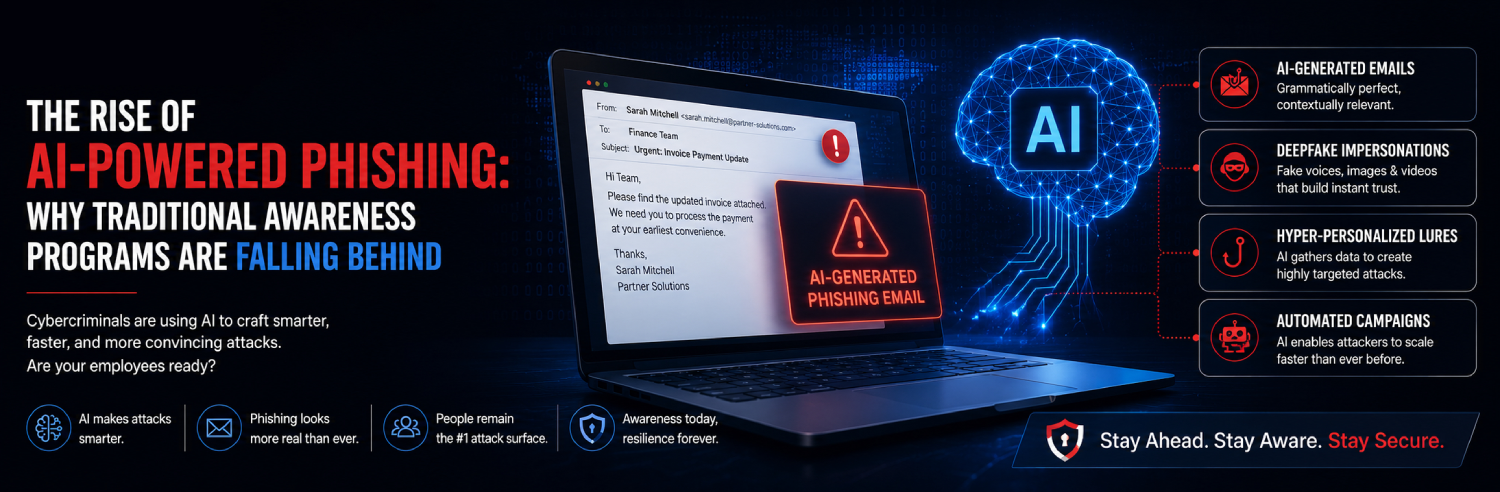
The Rise of AI-Powered Phishing: Why Traditional Awareness Programs Are Falling Behind
For years, we taught employees to spot phishing by its seams. Look for the clumsy grammar, we said. Watch for the generic “Dear Customer” greeting, the strange phrasing, the urgency that does not quite fit. Those tells worked because phishing was, frankly, a numbers game run by people who did not speak the victim’s language and could not afford to personalize at scale. That era is over. Generative AI has erased the seams, and the awareness programs built to teach people about those seams are now teaching them to look for a problem that no longer exists.
This is not a gradual shift. It is a step change. AI-powered scams surged 1,210% in 2025, with projected losses reaching roughly $40 billion by 2027. By late 2025, AI-generated phishing had become the top enterprise email threat. The defenders’ playbook was written for a world that disappeared in about eighteen months.
When the Telltale Signs Vanish
The most immediate casualty of AI phishing is the advice we have given employees for two decades. The broken English is gone, replaced by fluent, natural prose in any language the attacker wants, including regional ones. The generic greeting is gone, because AI can read a target’s public footprint and address them by name, reference their actual job, and mention a real project or recent event.
The effect on results is stark. A Brightside AI study found that AI-written phishing emails achieved roughly 54% click-through rates compared with about 12% for traditional phishing—roughly four and a half times more effective. Sit with that multiplier for a moment. The same number of attacks now lands four and a half times more often. An organization that felt reasonably safe at a 12% click rate is suddenly bleeding clicks, and nothing about its defenses has changed. Only the quality of the attack has.
What makes this so dangerous is that the new emails do not trip the instincts we have trained. They feel right. They sound like a real colleague, a real vendor, a real bank. The cognitive shortcut we taught—”if it looks off, be suspicious”—now produces a false sense of safety, because the messages no longer look off.
Personalization at Industrial Scale
The deeper threat is not just that AI writes better emails. It is that AI removes the historic trade-off between quality and quantity. In the past, a highly tailored attack required hours of manual research and could only target a handful of people. A mass campaign could reach thousands but was crude. Attackers had to choose.
AI dissolves that choice. It can scrape public profiles, news, and social media, then generate thousands of individually tailored messages, each referencing the specific recipient’s role, employer, and interests. The spear-phishing precision once reserved for high-value targets is now available against everyone in your organization, simultaneously, at almost no cost. Every employee is now worth attacking with a custom lure.
And these systems adapt. AI-driven campaigns can test which subject lines, tones, and pretexts work, then refine themselves—learning faster than any quarterly training cycle can hope to counter. The attacker’s content improves continuously while traditional awareness content sits frozen on a slide from last year.
Beyond Email: The Synthetic Voice and Face
If AI-written email were the whole story, it would be serious enough. But the same technology now fabricates voices and faces convincingly enough to defeat the trust we place in seeing and hearing someone.
The numbers describe an explosion. Deepfake files grew from roughly 500,000 in 2023 to about 8 million in 2025. Deepfake video scams rose more than 700% in 2025, and deepfake-enabled phishing climbed 310% between 2023 and 2025. Voice attacks followed: vishing surged 442% in 2025, and 41% of organizations were hit by a deepfake combined with social engineering on an audio call, with 35% experiencing it on a video call.
The most cited cautionary tale is the engineering firm Arup, which lost $25 million in 2024 after an employee joined a video call populated by what appeared to be the company’s CFO and several colleagues—all deepfakes. The employee did exactly what a diligent person should: they sought confirmation by getting on a call with the people involved. The attack defeated that instinct by faking the very confirmation. No awareness slide warns you that the face on your screen and the voice in your ear might both be fabricated.
Attacks are also fragmenting across channels to slip past single-channel defenses. Some 41% of phishing incidents are now multi-channel, blending email, SMS, QR codes, and voice into a single campaign. A target might receive an email, a confirming text, and a follow-up call, each reinforcing the others’ credibility. Awareness training built around “the suspicious email” simply does not map to this reality.
Why the Old Program Cannot Be Patched
It would be comforting to think the fix is to update the slide deck—add a section on AI, mention deepfakes, refresh the examples. It will not be enough, for a structural reason. Traditional awareness programs are static and periodic, while AI-powered attacks are dynamic and continuous. You cannot win a real-time contest with an annual response.
Recall the Verizon 2025 DBIR finding that click and failure rates were largely unaffected by traditional one-off training—and that was measured against the older, weaker attacks. Against AI-generated lures that are four and a half times more effective, a once-a-year session is not merely insufficient. It risks creating dangerous overconfidence, sending employees back to work believing they can spot a threat whose entire purpose is to be unspottable by the old rules.
The honest conclusion is that we have to stop teaching people to detect bad writing and start building resilient habits that hold even when a message looks perfect: verifying requests through a second, independent channel; treating any urgent financial or credential request as a moment to slow down regardless of how legitimate it appears; and reporting anything that feels even slightly off without fear of looking foolish.
Defenses That Learn as Fast as the Attacks
The arrival of AI-powered phishing is not a reason for despair, but it is a reason to retire a comfortable assumption: that a yearly training and a sharp eye will keep an organization safe. The seams are gone. The attacks now learn and adapt. Our defenses have to learn and adapt too.
Conclusion
AI has erased the telltale signs—broken grammar, generic greetings, awkward tone—that awareness programs spent two decades teaching people to spot. The result is phishing that is far more convincing, highly personalized at scale, and increasingly delivered across multiple channels and even synthetic voice and video. A static, periodic program cannot win a real-time contest against attacks that refine themselves continuously. The path forward is to stop teaching people to detect bad writing and start building resilient habits that hold even when a message looks perfect.
How Shieldbyte Infosec Can Help
Shieldbyte Infosec designed ShieldPhish to keep pace with attackers who now evolve weekly. The platform runs continuous, realistic phishing simulations that reflect AI-era tactics—convincing personalized emails, multi-channel sequences, and the verification-defeating patterns behind voice and video deception—so practice mirrors what employees will genuinely face. After each encounter, in-the-moment coaching turns the experience into a habit that sticks rather than a slide that fades. A human risk score tracks whether behavior is actually improving across teams and roles, and adaptive training focuses effort where exposure is highest. Reporting gives leadership a clear, current view of how human risk is trending. When the attacks learn and adapt, your people deserve a program that does the same.