



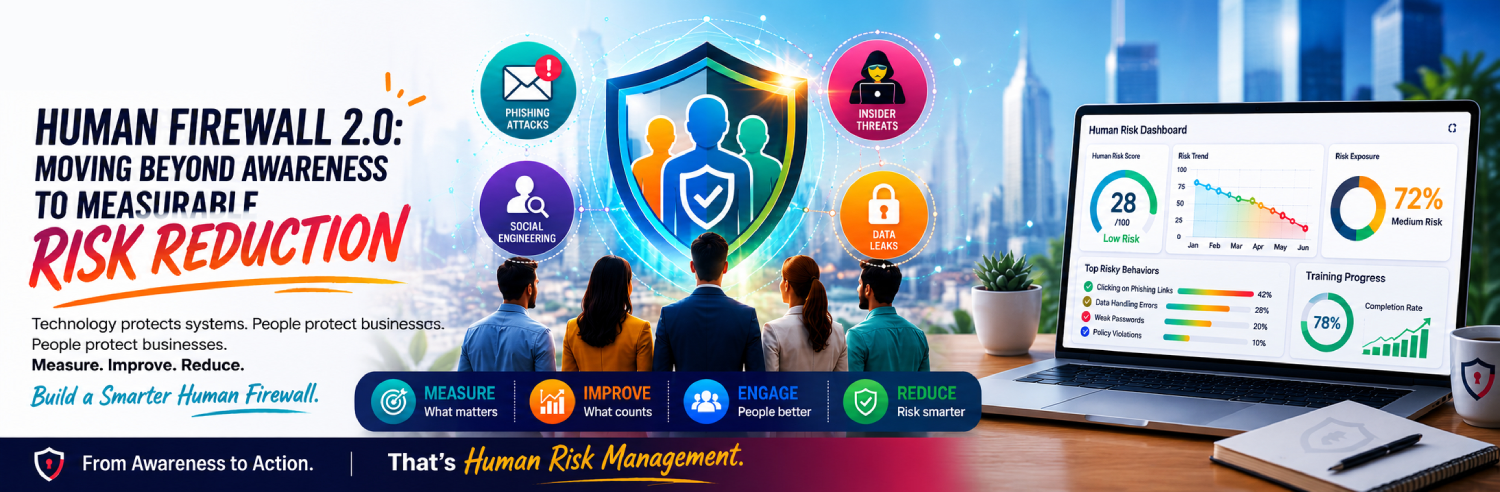
Human Firewall 2.0: Moving Beyond Awareness to Measurable Risk Reduction
The phrase “human firewall” has become one of the most quoted ideas in security. The intuition behind it is sound: if your people can recognize and resist attacks, they become a protective layer as real as any technology. The problem is that for most organizations, the human firewall has been more slogan than system. We named the concept, ran some training, and assumed the firewall was up. We rarely stopped to ask whether it actually worked—or how we would even know.
That gap between aspiration and evidence is what the next generation of security awareness has to close. Call it Human Firewall 2.0: a shift from hoping people are more aware to proving, with data, that human risk is actually going down. Because here is the uncomfortable foundation of the whole effort—roughly 60% of breaches involve a human element (Verizon 2025 DBIR). If most breaches run through your people, then managing human behavior is not a soft, secondary activity. It is core risk management.
Awareness Was Never the Goal
It is worth being honest about why awareness alone has underdelivered. Awareness measures inputs—sessions delivered, videos watched, quizzes passed—but security is determined by outputs, namely what people actually do when a real attack arrives. Those two things turn out to be only loosely connected.
The Verizon 2025 DBIR made this plain, finding that click and failure rates were largely unaffected by traditional one-off training. People could be fully “aware” in the sense of having attended and still behave exactly as before under pressure. Awareness is necessary but not sufficient. It is the equivalent of telling someone the rules of the road and assuming they can now drive in traffic.
The deeper issue is that “aware” is not measurable in any meaningful way. You cannot put a number on it, track it over time, or compare one department to another. And what you cannot measure, you cannot manage. The first move toward a real human firewall is therefore to stop measuring awareness and start measuring behavior and risk.
From Vague Worry to a Risk Score
The breakthrough idea in Human Risk Management is deceptively simple: treat human risk the way you already treat every other risk in the business—as something you can quantify, monitor, and reduce deliberately. That starts with giving it a number.
Modern approaches build a risk score for individuals, teams, and the organization as a whole, drawn from observed behavior rather than self-reported confidence. Inputs typically include how people respond to realistic phishing simulations, whether and how quickly they report suspicious messages, their access to sensitive systems and data, and how their behavior trends over time. The result is not a verdict on whether someone is “good” or “bad.” It is a living indicator of where exposure concentrates.
This changes the conversation entirely. Instead of “we did our annual training,” leaders can say “human risk in the finance team dropped 30% over two quarters, while the new sales hires are our current hotspot, and here is the plan.” That is the language the rest of the business already speaks—the language of measurable risk, trends, and targeted action.
Behavior Analytics: Seeing the Real Picture
A risk score is only as good as the behavior it observes, and this is where analytics earns its place. Rather than treating every employee identically, behavior analytics reveals the actual contours of risk across an organization—and they are almost never uniform.
In practice, the patterns that emerge are clarifying:
1. Risk concentrates. A relatively small group of roles or individuals often accounts for a disproportionate share of risky actions, especially those with privileged access or heavy external contact.
2. Context matters more than character. The same person may be sharp in the morning and vulnerable when rushed before a deadline, or far more exposed to lures tied to their specific job.
3. Reporting is a leading indicator. Teams that report suspicious messages quickly are demonstrably more resilient than teams with high “awareness” but silent inboxes.
With this visibility, defense stops being a blunt instrument applied equally to everyone and becomes a precise one. You can direct the most support to the people and moments that carry the most risk, rather than spending the same effort on a low-risk back-office team as on a finance department fielding payment requests all day. It is the difference between watering an entire field and irrigating the rows that are actually dry.
Closing the Loop: Practice, Feedback, Improvement
Measurement on its own does not reduce risk; it only reveals it. The human firewall strengthens when measurement feeds directly into action through a continuous loop—simulate a realistic attack, observe what happens, coach in the moment, then measure again to confirm whether behavior actually changed.
The timing of the coaching is what makes this work. The instant after someone interacts with a simulated lure is the single most teachable moment available, far more potent than a scheduled session weeks later. Short, relevant feedback delivered right then connects cause and effect while it is vivid. Repeated over time, and varied to reflect how attackers actually operate, this loop builds genuine instinct rather than fragile memorized rules.
It also reframes the entire relationship with employees. Done well, this is not about catching people out or punishing failure—an approach that only teaches people to hide mistakes. It is about coaching, the way any good team improves through practice and feedback. The metric that should rise over time is not just fewer clicks but more reporting, because an organization where people confidently flag anything suspicious has built something a static training program can never produce: a workforce that actively defends itself.
This continuous, evidence-based discipline also speaks directly to the regulatory moment. India’s DPDP Act, with rules finalized in November 2025 and compliance expected by around mid-2027, requires reasonable security safeguards, a data protection officer, data protection impact assessments, and audits—with penalties reaching ₹250 crore for safeguard failures. A documented, measurable program of human risk reduction is exactly the kind of evidence that demonstrates due diligence rather than mere intention.
Build a Firewall You Can Actually Measure
The first generation of the human firewall was an idea we believed in but never truly tested. We ran the training, hoped for the best, and had no way to know if it worked. Human Firewall 2.0 replaces that hope with evidence—risk scores you can track, behavior analytics that show where exposure really lives, and a continuous loop of practice and feedback that drives the numbers down.
Conclusion
The first human firewall was a slogan we believed in but never tested, measuring inputs like sessions delivered while security is decided by what people actually do. With roughly 60% of breaches involving a human element, managing human behavior is core risk management, not a soft add-on. Human Firewall 2.0 closes the gap between aspiration and evidence by treating human risk as something to quantify, monitor, and deliberately reduce. If you cannot currently say whether your human risk went up or down last quarter, that is not a small gap—it is the gap, and it is entirely closable.
How Shieldbyte Infosec Can Help
Shieldbyte Infosec built ShieldPhish around the principle that human risk should be measured and managed, not merely raised awareness about. The platform produces a human risk score for individuals, teams, and the whole organization, drawn from observed behavior—how people respond to realistic phishing simulations, how quickly they report suspicious messages, and how their behavior trends over time. Behavior analytics surface where risk truly concentrates, so support is directed to the roles and moments that carry the most exposure rather than spread evenly across everyone. Continuous simulation paired with in-the-moment coaching closes the loop, building genuine instinct instead of fragile memorized rules, while encouraging reporting as a sign of a workforce that defends itself. Clear reporting gives leadership the language of measurable risk, trends, and targeted action—and the documented evidence of due diligence that a tightening regulatory environment increasingly expects.