



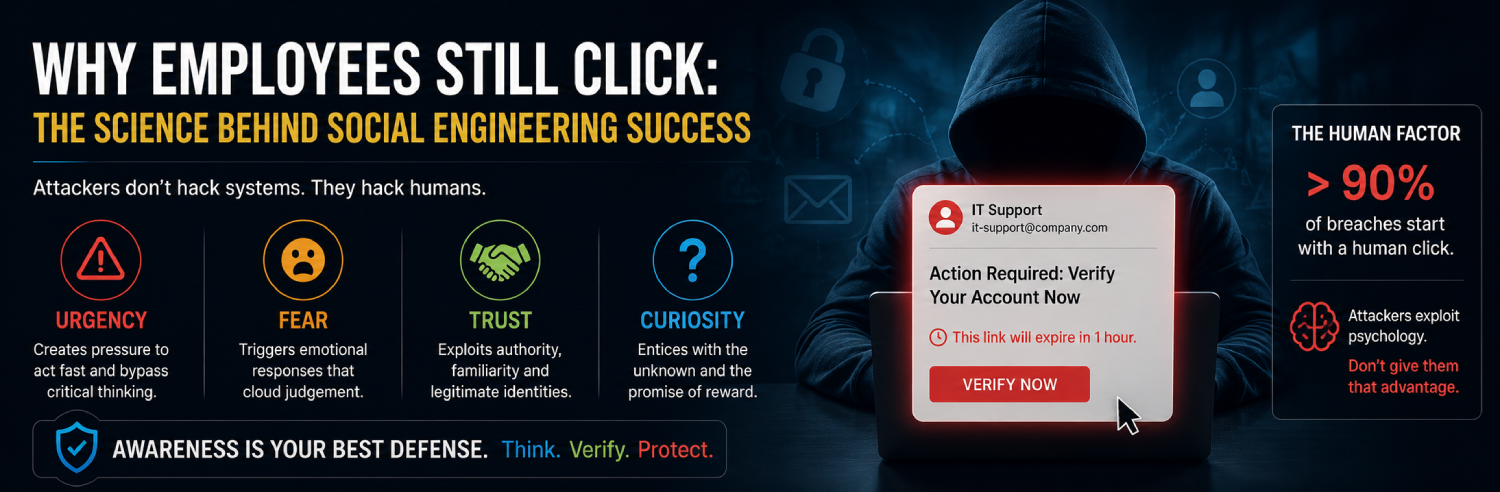
Why Employees Still Click: The Science Behind Social Engineering Success
Every organization has invested in security awareness, posted the reminders, and circulated the warnings. And yet, people still click the malicious link, still open the booby-trapped attachment, still approve the fraudulent payment. It is tempting to conclude that employees are simply careless. They are not. The reason intelligent, conscientious people fall for these attacks is that social engineering does not target their knowledge — it targets their psychology. Attackers have become expert students of human behavior, and understanding the science behind why we click is the first step toward building people who don’t.
We Are Built to Trust First
Human beings are fundamentally cooperative creatures. We assume, by default, that a message from a colleague is genuine, that an email from a known brand is legitimate, and that a request framed as routine is, in fact, routine. This default trust is not a flaw; it is what allows organizations to function without verifying every single interaction. But it is also the seam attackers pry open. They do not need to break your defenses if they can simply present themselves as someone you already trust.
This is why the human element is so central to modern breaches. Around 60% of breaches involve a human element (Verizon 2025 DBIR), and 16% of breaches begin with phishing. These are not statistics about ignorance; they are statistics about trust being exploited. The attacker borrows the credibility of a familiar name, a known logo, or an authoritative title, and lets our natural inclination to cooperate do the rest.
The Four Emotional Triggers Attackers Rely On
Social engineering works by hijacking the fast, automatic part of our thinking — the part that reacts before it reflects. A handful of emotional triggers reliably bypass careful judgment, and nearly every effective scam leans on at least one of them.
1. Urgency: “Your account will be suspended in one hour.” A deadline pressures us to act before we think, collapsing the window in which we might pause and verify.
2. Fear: “Suspicious activity detected on your account.” Anxiety narrows our focus and pushes us toward the quick action that promises relief.
3. Authority: A message that appears to come from the CEO, IT, or a regulator triggers compliance, because questioning authority feels risky.
4. Curiosity and reward: “You’ve received a shared document” or “Here is your bonus statement.” Curiosity and the lure of a benefit draw us in before skepticism can engage.
What unites these triggers is that they all push us out of slow, deliberate reasoning and into fast, reflexive reaction. The attacker’s entire goal is to keep you in that reflexive mode just long enough to click.
Why Smart People Are Not Immune
One of the most damaging myths in security is that only the inattentive get fooled. In reality, the people most likely to fall for a well-crafted lure are often the busiest and most diligent — those processing hundreds of messages a day, eager to be responsive and helpful. A tailored, plausible message arriving in the middle of a hectic afternoon is the perfect storm. The recipient is not being foolish; they are being efficient, and efficiency is exactly what the attacker is counting on.
This human reality is why traditional training so often disappoints. Verizon’s 2025 research found that click and failure rates were largely unaffected by traditional one-off training. Knowing intellectually that phishing exists does not change the split-second emotional response when a convincing message lands. Awareness lives in the slow, reflective brain. The click happens in the fast, reactive one. Closing that gap requires more than information.
AI Has Made the Bait Irresistible
If the psychology was already a challenge, artificial intelligence has raised the difficulty sharply. The old tells of a scam — broken grammar, awkward phrasing, generic greetings — are vanishing. AI can now generate flawless, personalized messages at massive scale, perfectly tuned to trigger urgency, fear, or curiosity. AI scams surged 1,210% in 2025, with projected losses of around $40 billion by 2027. AI-generated phishing became the top enterprise email threat by late 2025, and AI-written phishing emails achieved roughly 54% click-through versus about 12% for traditional phishing — nearly 4.5 times higher (Brightside AI study).
The implication is sobering. The visual cues we taught people to look for are disappearing, and the emotional manipulation is becoming more precise. This means we can no longer rely on employees spotting a “badly written” email. The defense has to operate at the level of behavior and instinct, not just the surface appearance of a message.
Building Instinct, Not Just Awareness
If clicking is driven by fast, emotional reaction, then the defense must train that fast system, not just the slow one. This is the difference between knowing about phishing and developing a genuine instinct to pause. That instinct — a small internal hesitation when a message provokes urgency or fear — is built through experience, not instruction.
The most effective approach mirrors how people learn any reflex: realistic, repeated practice with immediate, supportive feedback. When employees occasionally encounter safe simulated attacks that use the very same psychological triggers real attackers use, and then receive a brief, blame-free coaching moment, the lesson lands where it matters — in the reactive brain that actually decides whether to click. Over time, people develop a quiet habit of slowing down at exactly the moments attackers hope they will speed up.
Conclusion
Employees do not click because they are careless; they click because social engineering targets the fast, emotional part of the brain that reacts before it reflects. Urgency, fear, authority, and curiosity reliably bypass careful judgment, and the busiest, most diligent people are often the most exposed. AI has sharpened these lures and erased the old visual tells, so we can no longer rely on people spotting a badly written email. Because awareness lives in the slow brain while the click happens in the fast one, information alone cannot close the gap. The path forward is not to shame the human element but to strengthen it — to build the instincts that let people stay one step ahead of the science working against them.
How Shieldbyte Infosec Can Help
Shieldbyte Infosec’s ShieldPhish platform is built on this very insight: instead of lecturing people about a threat they already know exists, it trains the reactive brain that actually decides whether to click. ShieldPhish runs safe, realistic simulations that use the same emotional triggers — urgency, fear, authority, curiosity — that real attackers rely on. Every stumble becomes a brief, blame-free coaching moment that builds confidence rather than shame. The platform continuously scores human risk so you can see how instincts are developing across teams and where extra practice is needed, and adapts training to focus on those people. Clear reporting then translates that progress into a picture leadership can act on. If you would like to understand how your team responds to those triggers today, that is a conversation we would welcome.