



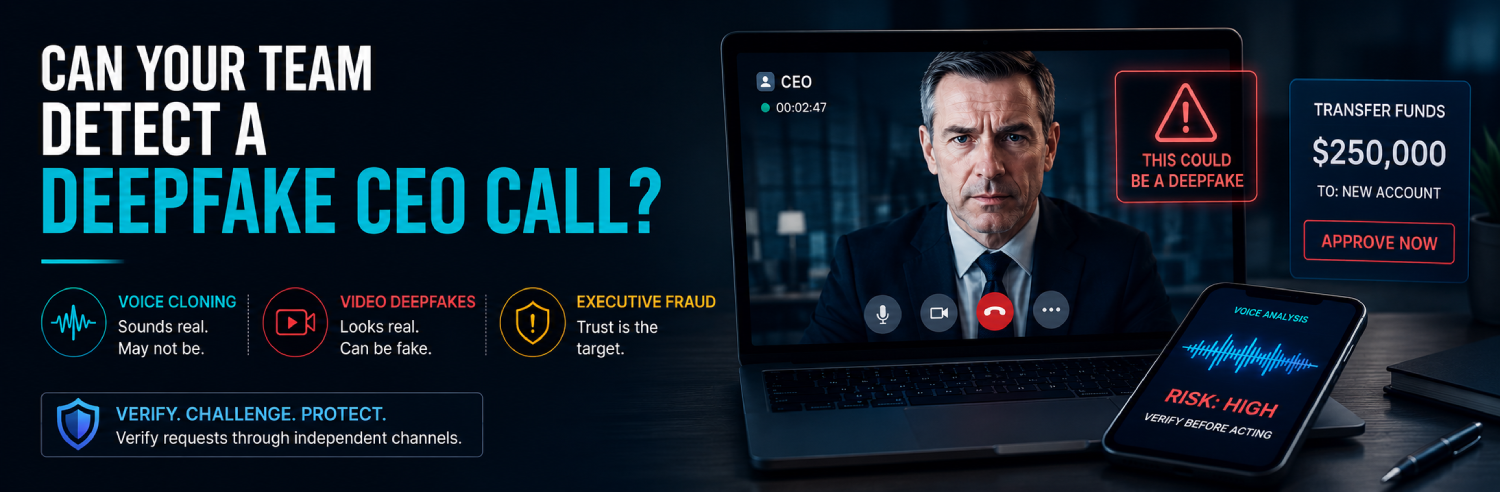
Can Your Team Detect a Deepfake CEO Call?
Imagine one of your finance managers receives a video call. On screen is the CFO — the right face, the right voice, the familiar mannerisms — joined by two colleagues she recognizes. The CFO explains there is a confidential acquisition underway and an urgent transfer is needed before markets open. Everything looks and sounds exactly right. So she makes the transfer. The trouble is that none of the people on that call were real. This is not a hypothetical. In 2024, the engineering firm Arup lost $25 million to precisely this kind of deepfake video call, in which fraudsters impersonated its CFO and other colleagues. The uncomfortable question every leader should now ask is simple: could it happen here?
When Seeing and Hearing Stopped Being Believing
For most of human history, recognizing a familiar face or voice was a reliable shortcut for trust. That shortcut is breaking down. Artificial intelligence can now clone a voice from a few seconds of audio and generate convincing video of someone who never said the words attributed to them. The raw materials are everywhere — earnings calls, conference talks, podcast appearances, social videos. Executives, by the nature of their roles, are the most exposed because their voices and faces are the most public.
The growth has been explosive. The number of deepfake files in circulation jumped from roughly 500,000 in 2023 to about 8 million in 2025. Deepfake video scams rose by 700% in 2025, and deepfake phishing climbed 310% between 2023 and 2025. This is no longer a novelty confined to research labs. It has become a practical tool in the fraudster’s kit, and it is being aimed squarely at the people authorized to move money and make decisions.
The Voice on the Phone
While the video deepfake grabs headlines, the audio version is arguably the more immediate danger because it is cheaper and easier to pull off. Voice-based phishing — “vishing” — surged 442% in 2025. In one striking finding, 41% of organizations had been hit by a deepfake combined with social engineering on an audio call, and 35% on a video call.
Picture the scenario from the receiving end. The phone rings, the caller ID looks plausible, and the voice is unmistakably the boss’s. There is pressure, a deadline, a reason it must stay quiet. Every cue your brain uses to verify identity has been satisfied, and the one cue that would save you — independent verification through a separate channel — is the very thing the urgency is designed to prevent. That is the engine of executive fraud: not technical wizardry alone, but the marriage of convincing impersonation with psychological pressure.
Why Executives Are the Perfect Target
Attackers think in terms of return on effort, and executive impersonation offers an unusually high one. A successful business email compromise or executive-fraud scheme can yield enormous sums in a single transaction. The FBI’s IC3 reported that business email compromise caused $3.046 billion in losses across 24,768 complaints in 2025 — an average of roughly $123,000 per incident — while total US cybercrime losses reached $20.877 billion, up 26% year over year.
Several factors make leadership impersonation effective:
1. Authority short-circuits scrutiny. When the request appears to come from the top, employees are reluctant to push back or slow things down.
2. Executives are publicly documented, giving attackers ample voice and video samples to work from.
3. Senior leaders often operate with urgency and confidentiality, which are the exact conditions a scam exploits.
4. The financial decisions executives influence are large, so a single success pays for many failed attempts.
The result is a threat that targets your most trusted relationships and your most consequential transactions at the same time.
The Defense Is a Culture, Not a Camera
It is tempting to hope that some detection software will simply flag the fakes. Technology helps, and detection tools are improving, but they are locked in an arms race with the generators and will never be a complete answer. The durable defense is organizational, not purely technical, and it rests on one principle: high-stakes requests must be verified through an independent, pre-agreed channel, no matter how convincing the source appears.
In practice that means building habits and processes that hold even under pressure:
1. A callback rule for any urgent financial request — verification via a known number, not the one provided in the call or message.
2. A culture where questioning an unusual request from leadership is encouraged, not career-limiting.
3. Clear, multi-person approval steps for fund transfers above set thresholds, so no single deceived employee can complete the chain alone.
4. A shared “safe word” or verification protocol for sensitive verbal authorizations.
None of these require an employee to out-detect an AI. They simply remove the conditions — speed, secrecy, and a single point of failure — that deepfakes depend on.
Practising for the Call You Hope Never Comes
The hardest part is that these habits must work in the heat of the moment, when an employee genuinely believes they are talking to their CEO. You cannot install that composure with a slide deck. People build it through realistic rehearsal, the same way fire drills make calm evacuation automatic. When teams experience safe, simulated vishing and deepfake-style pressure scenarios — and then receive supportive coaching afterward — the verification reflex becomes second nature rather than something they remember only in hindsight.
Conclusion
Deepfakes have changed what a trustworthy face and voice are worth, and they are being aimed directly at the people authorized to move money. Detection software will always trail the generators, so the real defense is organizational: independent verification, multi-person approval, and a culture that rewards questioning urgent requests. These controls remove the speed, secrecy, and single point of failure that deepfake fraud depends on. But they only work if your people have rehearsed them, because composure under pressure cannot be installed with a slide deck. The organizations that adapt will be those that teach their teams to trust the process, not just the picture.
How Shieldbyte Infosec Can Help
Shieldbyte Infosec’s ShieldPhish platform extends phishing simulation beyond email into the voice and multi-channel scenarios that deepfake fraud now exploits. By exposing teams to safe, realistic vishing and deepfake-style pressure tests, ShieldPhish helps the verification reflex become automatic rather than something remembered only in hindsight. Each simulation turns into a brief, encouraging coaching moment, building confidence instead of fear. ShieldPhish also scores human risk so you can identify which roles and individuals are most exposed to executive-targeted fraud, and adapt training accordingly. Clear reporting then gives leadership a grounded view of how resilient the organization is to these high-stakes attacks. If you have ever wondered whether your team would pass that test, now is a good time to find out — safely.