



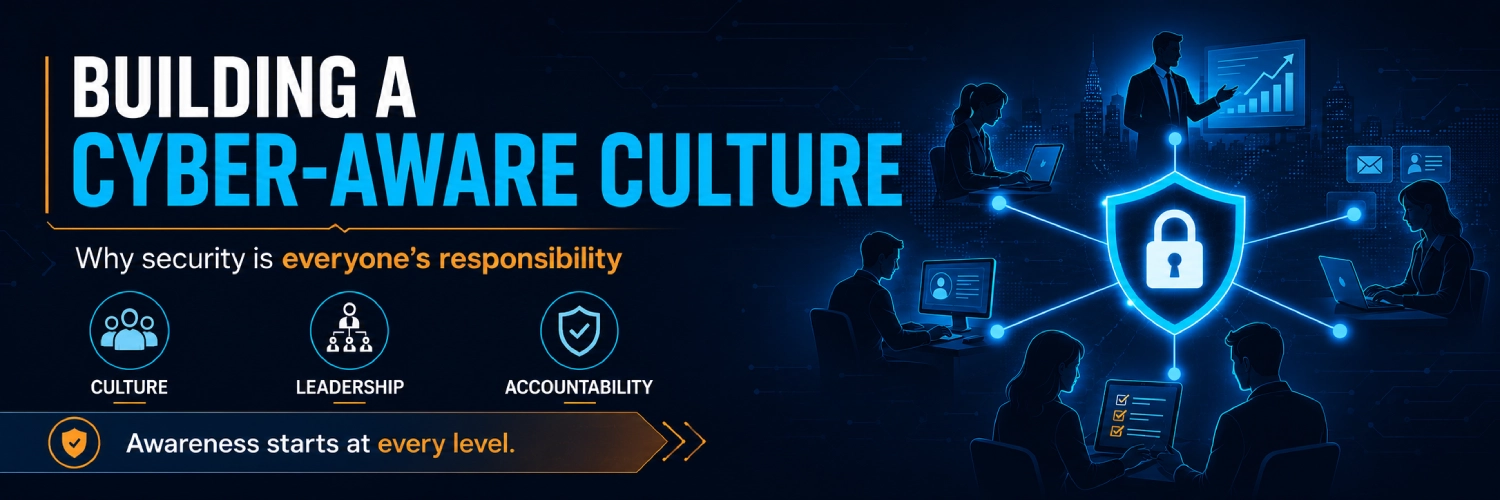
Building a Cyber-Aware Culture: Why Security Is Everyone's Responsibility
For a long time, security was treated as a department. It lived in the IT corner of the organization, owned by specialists who installed the right tools and quietly kept the lights on. That model made sense when threats arrived mostly through technical channels. It makes far less sense today, when the most effective attacks are aimed not at systems but at people. The reality now is that around 60% of breaches involve a human element (Verizon 2025 DBIR), which means the strongest firewall in your organization is not a piece of software. It is the collective judgment of everyone who opens an email, answers a call, or scans a code. Building that judgment is a matter of culture, not just technology.
Security Stopped Being an IT Problem
The shift happened gradually, then suddenly. As technical defenses improved, attackers changed their approach. Rather than breaking through hardened systems, they began persuading people to open the door from the inside. Phishing, business email compromise, and social engineering all rely on the same insight: it is easier to fool a person than to crack a well-defended network.
This is why security can no longer be delegated entirely to a technical team. The receptionist who receives an urgent call, the finance clerk who processes an invoice, and the executive who approves a payment are all now part of the security perimeter. They make decisions every day that determine whether an attack succeeds or fails. If they have not been brought into the security conversation, the most sophisticated tools in the world cannot fully protect them, or the organization they serve.
Why Annual Training Quietly Fails
Many organizations believe they have addressed this by running annual security training. Everyone watches the video, passes the quiz, and the box is ticked for another year. The trouble is that this approach does not reliably change behavior. Verizon found that click and failure rates were largely unaffected by traditional one-off training (Verizon 2025 DBIR).
The reason is simple. Awareness is not a fact to be memorized once; it is an instinct that develops through repetition. A single annual session asks people to recall, months later and under pressure, a lesson they half-remember from a slideshow. That is not how human judgment is built. Skills that need to fire in a split second, such as pausing before clicking a link that feels slightly off, only become reliable through regular, realistic practice. Culture is what fills the long gap between training sessions, and an annual checkbox does little to shape it.
Leadership Sets the Temperature
A cyber-aware culture cannot be mandated from the middle. It is set at the top, in ways that are often more about behavior than about policy. When leaders treat security as a genuine priority rather than a compliance obligation, that attitude flows downward. When they treat it as an afterthought, that flows downward too.
Practical leadership involvement looks less like a memo and more like participation. Executives who take the same phishing simulations as their teams, who talk openly about a time they nearly fell for a scam, and who respond to reported incidents with curiosity rather than blame send a powerful signal. They make it clear that security is something the whole organization does together, not something done to employees by a watchful IT department. The tone leaders set determines whether people feel safe reporting a mistake, and that single factor often makes the difference between an incident contained in minutes and one discovered weeks too late.
Replacing Blame With Accountability
There is an important distinction between blame and accountability, and a healthy culture depends on getting it right. Blame punishes the individual who made a mistake. Accountability asks what the organization can learn so the next person does not make the same one.
When employees fear punishment, they hide their errors. Someone who clicks a malicious link and realizes it moments later may stay silent rather than face embarrassment, and that silence is exactly what an attacker is counting on. The hours between a click and its discovery are often when the real damage is done. A culture that encourages people to raise their hand the moment something feels wrong turns every employee into an early-warning system.
This shift is subtle but profound. It reframes the person who reports a mistake not as a liability but as a contributor to the organization’s defense. The goal is not a workforce that never errs, which is impossible, but a workforce that surfaces problems quickly and without fear.
Making Awareness Part of the Everyday
Culture is built in small, repeated moments rather than grand gestures. The organizations that succeed weave security into the ordinary rhythm of work instead of confining it to an annual event. A few approaches tend to work well:
1. Run frequent, realistic simulations that reflect the threats people actually face, including AI-generated emails, voice calls, and QR-code lures, so practice mirrors reality.
2. Celebrate good catches publicly, recognizing employees who report suspicious messages so that vigilance feels valued rather than thankless.
3. Keep the conversation alive through brief, regular touchpoints rather than long, infrequent ones, because steady reinforcement beats occasional intensity.
This matters more than ever as threats grow more convincing. AI-generated phishing became the top enterprise email threat by late 2025, and AI scams surged 1,210% in 2025 (industry data). When the attacks are this realistic, only a workforce in regular practice can keep pace.
A Shared Responsibility Worth Building
A cyber-aware culture is not built by a tool or a policy alone. It grows when leaders model the behavior they expect, when mistakes are met with learning rather than blame, and when awareness is reinforced through steady, realistic practice rather than an annual ritual. Security truly is everyone’s responsibility, and the organizations that embrace that idea are the ones that find it becomes second nature.
Conclusion
As attacks increasingly target people rather than systems, the strongest defense an organization has is the collective judgment of everyone who opens an email, answers a call, or scans a code. That judgment is a matter of culture, and culture cannot be installed like a tool or ticked off like an annual quiz. It is shaped by leaders who treat security as a genuine priority, by an environment that replaces blame with accountability so people report mistakes quickly, and by steady, realistic practice that builds instinct between formal training. The organizations that get this right are the ones where vigilance becomes second nature.
How Shieldbyte Infosec Can Help
Shieldbyte Infosec designed ShieldPhish to support exactly this kind of culture rather than another box to tick. The platform runs continuous phishing simulations that reflect the threats employees actually face, including AI-generated emails, voice calls, and QR-code lures, so practice mirrors reality. Human-risk scoring helps identify where reinforcement is most needed, while adaptive training keeps the conversation alive through brief, regular touchpoints instead of one long annual event. Reporting gives leadership a clear picture of how the culture is maturing and lets them participate visibly in the program alongside their teams. The result is a steady move beyond the checkbox toward continuous human-risk management that turns every employee into an active part of the defense. If you are ready to make awareness part of how your people work, the foundation is worth laying now.