



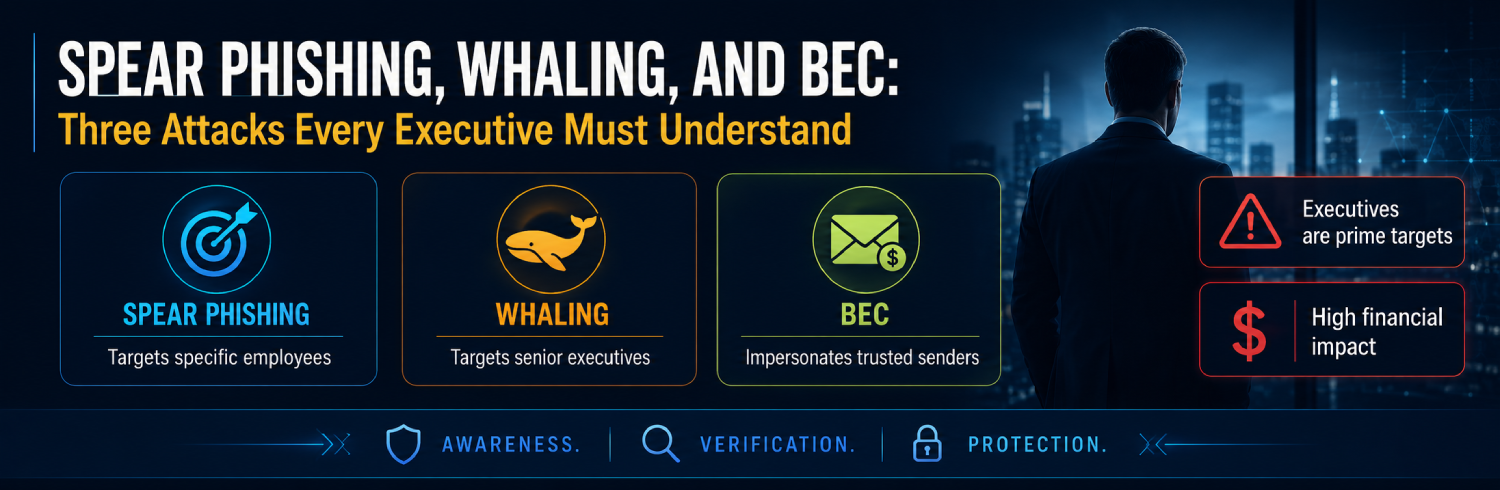
Spear Phishing, Whaling, and BEC: Three Attacks Every Executive Must Understand
Most leaders know the word “phishing” and picture a clumsy, misspelled email promising a lottery win. That image is comfortingly outdated. The attacks that actually drain corporate bank accounts and breach sensitive systems are precise, researched, and tailored. They go by names that sound like a marine documentary — spear phishing, whaling, and business email compromise — but they share a single underlying idea: instead of casting a wide net, the attacker studies a specific target and crafts a message that target is primed to believe. Understanding the differences between these three is not academic. It is the difference between recognizing a threat and authorizing a wire transfer to a criminal.
From Mass Mailings to Sniper Fire
Ordinary phishing is a numbers game. Send a million generic emails, and a small percentage of people will click. Spear phishing flips that logic. Rather than volume, it relies on relevance. The attacker researches an individual — their role, their colleagues, a recent project, even a vacation mentioned on social media — and writes a message that fits naturally into that person’s day. An email referencing a real client by name, sent at a believable moment, is far harder to dismiss than a generic alert.
Phishing remains the stubborn front door for intruders. In the Verizon 2025 DBIR, 16% of breaches began with phishing, and phishing accounted for roughly 14% of breach action varieties. Around 60% of breaches involve a human element. Spear phishing is what makes these numbers so durable: when a message is personalized, even careful, well-meaning employees are far more likely to act on it. It is precision, not volume, that does the damage.
Whaling: When the Target Wears the Crown
Whaling is spear phishing aimed at the biggest fish in the organization — the executives, the board members, the people with broad authority and access. The principle is the same as spear phishing, but the stakes and the tailoring rise sharply. A whaling email might pose as a legal matter requiring the CEO’s discreet attention, or as a board communication that demands an immediate, confidential response.
What makes whaling so potent is the authority that surrounds senior leaders. An assistant or a junior colleague who receives a request that appears to come from the CEO faces enormous social pressure to comply quickly and without question. The attacker is not just impersonating a person; they are borrowing that person’s power. And because executives are so publicly visible — quoted in press, featured on the company website, active on professional networks — there is abundant raw material to make the impersonation convincing.
BEC: The Quiet Billion-Dollar Heist
Business email compromise, or BEC, is where these techniques translate most directly into financial loss. In a BEC scheme, the attacker either impersonates or actually takes over a trusted email account — a senior executive, a finance leader, or even a vendor — and uses it to request payments, redirect invoices, or extract sensitive data. There is often no malicious link or attachment at all, which is precisely why so many security tools miss it. The email is just words, and the words are an instruction the recipient has every reason to follow.
The financial toll is staggering. The FBI’s IC3 reported that BEC caused $3.046 billion in losses across 24,768 complaints in 2025, an average of roughly $123,000 per incident. Total US cybercrime losses reached $20.877 billion, up 26% year over year. These are not abstract figures. Each one represents a real organization where a believable email led to a payment that should never have been made.
How They Differ, and Why It Matters
It helps to hold these three side by side, because the right defense depends on understanding what each one exploits.
1. Spear phishing targets a specific individual with a researched, personalized message; the goal is often to harvest credentials or plant a foothold.
2. Whaling is spear phishing pointed at senior leaders, weaponizing their authority and visibility to pressure others into acting.
3. BEC focuses on the transaction itself — fraudulent payment or data requests sent from a spoofed or hijacked trusted account.
The connective tissue is human trust. None of these attacks needs to defeat your firewall if it can persuade a person to act. That is why the modern threat picture is increasingly multi-channel — 41% of phishing incidents now span email, SMS, QR, and voice — and why AI has poured fuel on the fire. AI-generated phishing became the top enterprise email threat by late 2025, and AI-written phishing emails saw roughly 54% click-through versus about 12% for traditional phishing, nearly 4.5 times higher (Brightside AI study). The personalization that once took an attacker hours now takes seconds.
Turning Knowledge Into Instinct
Knowing the taxonomy is a start, but recognition in the moment is what protects the organization. The good news is that the defenses are consistent across all three. Verify unusual financial requests through an independent channel. Build multi-person approval for significant transfers. Be especially alert when a message combines authority, urgency, and secrecy — the signature mix of executive-targeted fraud. And remember that for organizations under India’s DPDP Act, a breach stemming from one of these schemes carries real regulatory weight, with penalties reaching ₹250 crore for inadequate safeguards and a mandatory obligation to report every breach.
Crucially, these instincts are built through practice, not policy memos. Verizon’s 2025 research found that one-off training did little to change click rates. People learn to spot a tailored, executive-style lure by encountering safe versions of them and being coached, gently and promptly, when they slip.
Conclusion
Spear phishing, whaling, and BEC are not the clumsy scams of the past; they are precise, researched, and tailored to the people they target. What unites them is human trust — none needs to defeat your firewall if it can persuade a person to act, and AI has made that persuasion faster and more convincing than ever. The defenses are consistent across all three: independent verification of financial requests, multi-person approval, and heightened alertness when authority, urgency, and secrecy appear together. But knowing the taxonomy is not the same as recognizing the lure in the moment. The attackers have moved from mass mailings to sniper fire, and helping your people — especially your leaders — recognize the shot before it lands is one of the highest-return investments a business can make.
How Shieldbyte Infosec Can Help
Shieldbyte Infosec’s ShieldPhish platform delivers realistic spear phishing, whaling, and BEC-style simulations matched to your organization and its real workflows. By letting employees and leaders safely encounter the tailored lures attackers actually use, ShieldPhish converts each near-miss into supportive, prompt coaching that builds lasting judgment. The platform scores human risk across roles, surfacing which individuals and departments are most exposed to executive-targeted fraud. Adaptive training then concentrates effort where the risk is highest, rather than treating everyone the same. Reporting gives leadership a clear, defensible picture of how the organization stands against these costly schemes over time. If you would like to see how your team handles a tailored lure today, we would be glad to help you find out.